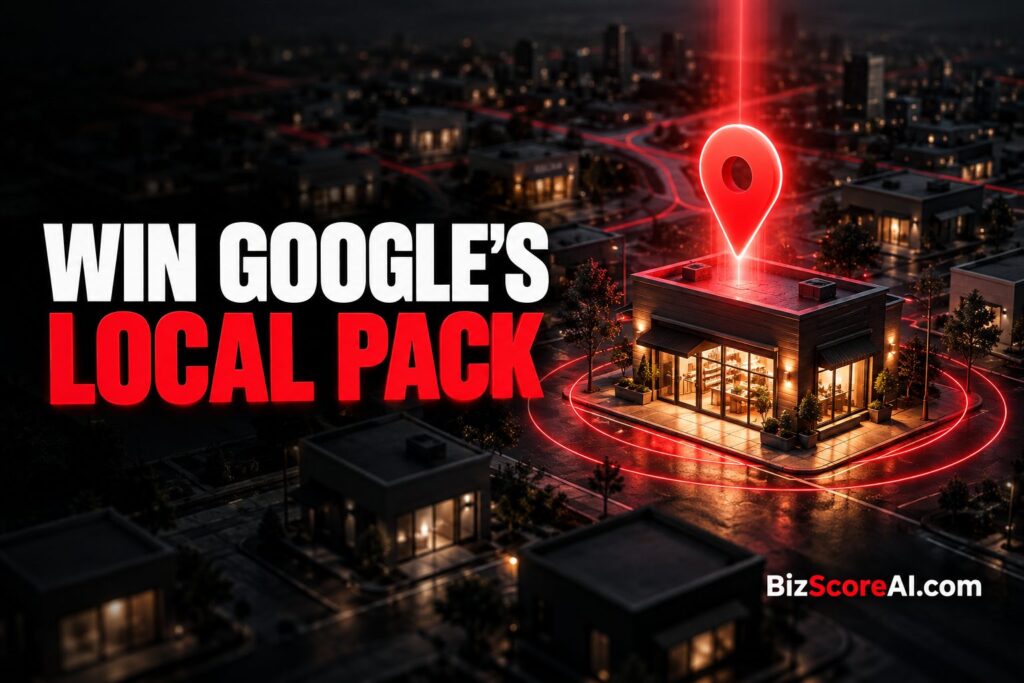
Local SEO gives a business a clear, consistent presence in the search results that matter most for nearby customers: the local pack, Google Maps, and the location-aware answers now coming from AI tools like ChatGPT and Perplexity. When a business’s name, address, services, and reviews all line up across the web, both Google and AI search platforms can recognize it, trust it, and recommend it to people searching in the area.
What does local SEO actually cover?
Local SEO is the work of making a business visible in unpaid, location-based search results. That includes the map listings on Google, the local pack of three businesses that appears under certain queries, the regular blue-link results that mention a city or neighborhood, and the written answers that AI search tools produce for queries such as “best coffee shop near me” or “emergency plumber in Brooklyn.”
It is different from national SEO. National SEO focuses on content and backlinks to rank a page for broad terms. Local SEO adds proximity, a fully built-out Google Business Profile, consistent name-address-phone (NAP) citations across the web, and structured data that tells a search engine exactly where the business is and what it does.
The businesses that benefit most have a physical location, a defined service area, or both. Restaurants, dentists, mechanics, law firms, plumbers, tutors, and dog walkers all sit in this category.
Why local SEO matters in 2026
When people search for a plumber, a dentist, or a coffee shop, they usually want results for a specific neighborhood. Search engines respond to that intent by surfacing local results, even when the query itself does not include a place name. A search for “hair salon” shows hair stylists near the searcher, not a generic explainer page.
The same local queries are now being answered directly by AI. Google AI Mode, ChatGPT, and Perplexity often name specific businesses in their responses instead of returning a list of links. The local SEO work that helps a business rank on Google is the same work that helps these AI tools find, verify, and describe that business correctly.
How local SEO works
Local SEO works by helping search systems understand three things: where a business is, what it offers, and how trustworthy it is.
For the local pack and Google Maps, Google weighs three factors:
- Relevance: how well the business matches what the searcher wants.
- Distance: how far the searcher is from the business or the area named in the query.
- Prominence: how well-known the business is, which includes reviews, ratings, citations, and links.
For organic (blue-link) results with local intent, Google also looks at page relevance, content quality, and usability signals like speed and mobile-friendliness.
AI search platforms approach the same problem differently but look for the same underlying signals. A 2026 analysis by SOCi, the Local Visibility Index, examined about 350,000 locations across 2,751 multi-location brands and found that the businesses AI platforms tend to recommend share four traits: complete and accurate business information across Google Maps, Yelp, Facebook, and their own websites; strong reviews with high ratings, steady volume, and active responses; differentiated local content that describes specific services, amenities, and specialties rather than generic copy; and a consistent cross-platform presence rather than strength on a single channel.
In other words, the inputs that improve a local pack ranking are the same inputs that make a business more likely to be named correctly in an AI answer.
How to do local SEO, step by step
Do local keyword research
Local keyword research means finding the actual search terms people use when they want a local product or service, then building (or updating) pages that target those terms. The goal is to attract people who are close to hiring, not just people who are reading.
Three reliable methods:
- Competitor research. A keyword gap tool that compares your domain against a few local competitors can surface terms they rank for that you do not. Filtering by search volume, difficulty, and intent helps narrow the list to terms worth chasing.
- Google Autocomplete. Typing a service plus a city into Google (for example, “emergency plumber in”) produces a dropdown of real queries. Adding modifiers like “emergency,” “same-day,” or “open now” surfaces queries from people who are ready to act.
- Google Keyword Planner. Originally built for paid search, Keyword Planner also returns local monthly search volumes, which are more useful than national averages when a business only serves a specific area.
When sorting the list, intent matters more than raw volume. “Emergency plumber” and “plumber near me” signal someone ready to call. A phrase like “toilet repair [city]” points to a specific job in a specific place. These terms often have lower search volume than broad ones, but they convert better.
Optimize your Google Business Profile
A Google Business Profile is a free listing that can appear in Google’s local results. The optimization work is straightforward: claim and verify the profile, then fill in every relevant field, including contact details, opening hours, photos, videos, and business attributes such as Wi-Fi, outdoor seating, or accessibility.
Completeness is a ranking signal, but it is also a trust signal for the searcher deciding which listing to click.
Keep your Business Profile active
An active profile tells Google and potential customers that the business is engaged. That means updating hours for holidays, posting news and offers on a regular cadence, and responding to reviews (both positive and negative).
Asking customers for reviews is part of the same loop. More reviews and higher ratings support rankings, and review responses are an opportunity to handle complaints in public.
Get and monitor local citations
Local citations are online mentions of a business’s name, address, and phone number. They come in two forms: structured citations on directories such as Google Business Profile, Yelp, Apple Maps, Bing Places, and Facebook, and unstructured citations on blogs, news sites, and other third-party pages.
Both matter, and consistency is the point. Exact-match NAP details across the web are how both Google’s local algorithm and AI search platforms confirm they are describing the right business when a searcher asks about it. Inconsistent listings (a different suite number on Yelp than on Google, a stale phone number on a directory from 2019) weaken that signal.
Encourage and respond to online reviews
Reviews are a ranking factor and a conversion factor. A steady stream of recent reviews, with thoughtful responses from the business, signals that the business is active and trusted. Tools that automate review requests and AI-generated replies can keep this work manageable.
Refine on-page SEO for local intent
On-page local SEO means making sure each page makes its geographic relevance obvious. That usually includes a city or neighborhood in the title tag, in the H1, and in the body copy, plus LocalBusiness or similar structured data on the page so search engines can read the address, hours, and service area directly.
Earn backlinks and mentions from local sources
Local links and mentions from newspapers, community sites, local blogs, and partner organizations are stronger relevance and prominence signals than generic directory links. Sponsoring a local event, contributing a column to a neighborhood publication, or being listed by a local chamber of commerce all count.
How to measure local SEO results
Local SEO is ongoing, not a one-time project. The work is only valuable if the rankings change, so measurement matters.
Track local pack and organic rankings at the ZIP code or city level, not just nationally. A business can rank on page one nationally and still be invisible in the three towns where it actually picks up jobs. Rank-tracking tools that check position from multiple points across a service area give a truer picture than a single national average.
For businesses whose customers might ask an AI tool for a recommendation, the equivalent question is whether the business is being named in AI answers. Visibility on AI search platforms is now a separate metric to watch, not an automatic side effect of Google rankings.
A technical audit of the underlying website still matters: page speed, mobile usability, and structured data all feed into both Google’s local results and the way AI tools read a site. The cleanest way to see what is actually being measured on a site is to run a full technical audit. SEOScanPro runs a full technical audit of a site and shows the measured result behind every check, including the local SEO signals and AI-readiness cues that influence both Google and AI search results.
FAQ
What is the difference between local SEO and national SEO?
National SEO focuses on ranking pages for broad, non-geographic terms using content and backlinks. Local SEO adds proximity, a Google Business Profile, consistent name-address-phone (NAP) citations, and location-specific structured data so a business can rank for queries tied to a city, neighborhood, or service area.
What are the main ranking factors for local SEO?
For the local pack and Google Maps, Google weighs relevance (how well the business matches the query), distance (how close the business is to the searcher or the named area), and prominence (how well-known the business is, including reviews, citations, and links). For organic results with local intent, standard page-level factors such as content quality and usability also apply.
How do AI search platforms like ChatGPT and Perplexity choose which local businesses to recommend?
According to SOCi’s 2026 Local Visibility Index, the businesses AI platforms recommend tend to have complete and consistent business information across the web, strong reviews with active responses, differentiated local content that describes specific services and specialties, and a consistent presence across multiple platforms rather than strength on a single channel.
Related coverage
- Fix My Local SEO – BizScoreAI
- Why Your Business Listing Score Depends on Technical SEO (2026 Guide) – BizScoreAI
- Clicks Down, Revenue Up: The Ecommerce SEO Metrics That Matter in 2026 – BizScoreAI
Try the business directory
The business directory scores how visible a business is to AI search and shows what its listing looks like to the engines people ask. Open the business directory.
This article summarizes reporting from semrush.com. See our editorial disclaimer for how our articles are produced.
Run a free scan to see your AI Visibility Score, SEO rating, and local citation accuracy.