
Site operators get clearer signals about how Google treats large product aggregators when crawl volume spikes but only a few URLs end up in the index. The core issue is twofold, covering technical redirect problems and the quality of programmatic, autogenerated content across hundreds of thousands of pages.
What the Search Console data revealed
A large product aggregator site reported 1.17 million Googlebot crawls in recent weeks, while Search Console listed four indexed URLs total out of an apparent 180,000 pages. The crawl chart showed a sharp spike in activity, and the page indexing report showed almost nothing retained. The home page itself was not indexed, which is unusual for a site of that scale.
Why crawling does not equal indexing
Crawling and indexing are separate stages. Googlebot can fetch URLs repeatedly to check for changes, but only URLs that pass quality and technical thresholds make it into the searchable index. A high crawl count combined with a near-empty index is a strong signal that something is blocking inclusion rather than blocking discovery.
The two issues Google identified
Technical redirect problems
The indexed URLs from the site all redirected to the home page. That pattern suggests unresolved technical issues, such as redirect chains, soft 404s handled through redirects, or URL canonicalization that collapses many pages into one destination. When Google follows a redirect and lands on the same home page for every URL, the indexed set collapses to a single result.
Programmatic SEO quality concerns
A large product aggregator that uses programmatic, autogenerated content faces a higher standard. Search engines need a clear signal that the generated URLs add value beyond what a template provides, and users need a reason to land on each page rather than the category or home page. Programmatic SEO at scale is hard to execute well, and Google has historically treated low-quality programmatic generation as a risk factor for indexing and ranking.
What this means for aggregator site operators
Audit the redirect layer first
Check whether distinct product URLs resolve to unique content rather than redirecting to the home page or a category page. Server-side 301 patterns, trailing slash rules, query string handling, and CMS-level redirects can all collapse URLs silently. A redirect audit across a representative URL set is the fastest way to confirm whether the index is shrinking at the redirect stage.
Review the programmatic content template
Look at what each generated page actually adds. If two product pages share most of their body text and differ only in a product name, price, and image, the pages look thin to a crawler evaluating them at scale. Adding unique, verifiable data per page, such as specifications, availability, reviews, and structured attributes, raises the floor for what each URL contributes.
Strengthen internal linking and canonical signals
Pages that are not linked from a discoverable path are easier for Google to deprioritize. Internal links from category pages, filters, and related product modules help crawlers find the full set of URLs and distinguish them from near-duplicates. Self-referential canonical tags on each unique product URL reduce ambiguity.
Monitor crawl versus index ratios over time
A widening gap is the warning sign. If crawl requests keep growing while the indexed count stays flat or shrinks, the site is spending crawl resources on URLs that do not earn a slot in the index. Search Console’s crawl stats and page indexing report, used together, give an early read on whether new URL templates are being accepted.
How aggregator sites earn indexing at scale
Google’s general guidance for large sites built on templates is consistent: unique value per URL, clean technical signals, and content that is genuinely useful to people searching for those products. Aggregators that succeed at scale typically combine first-party data, structured markup, and a content layer that goes beyond what manufacturers and marketplaces already publish.
What to do next
For a large product aggregator with a crawl-versus-index gap, the practical path forward is a redirect audit, a programmatic content review, and a crawl-to-index efficiency pass to surface where the index is being lost. Tools like SEOScanPro run a full technical audit and show the measured result behind each check, which is useful when the question is whether redirects or templates are collapsing the index.
FAQ
Why does Google crawl a large product aggregator so often?
Googlebot crawls URLs to detect changes, but crawling does not guarantee indexing. High crawl volume on a product aggregator often reflects repeated checks on generated pages, with most URLs failing to qualify for the index.
Can redirect issues prevent a home page from being indexed?
Yes. If many indexed URLs redirect to the home page, Google may treat the site as collapsing to a single destination, which can suppress the home page in the index and leave only a handful of URLs visible.
Does Google penalize programmatic SEO?
Google evaluates programmatic SEO on the quality of the output rather than the method itself. Aggregator pages that rely on autogenerated templates need unique, verifiable content per URL to earn indexing and ranking at scale.
Related coverage
SEOScanPro
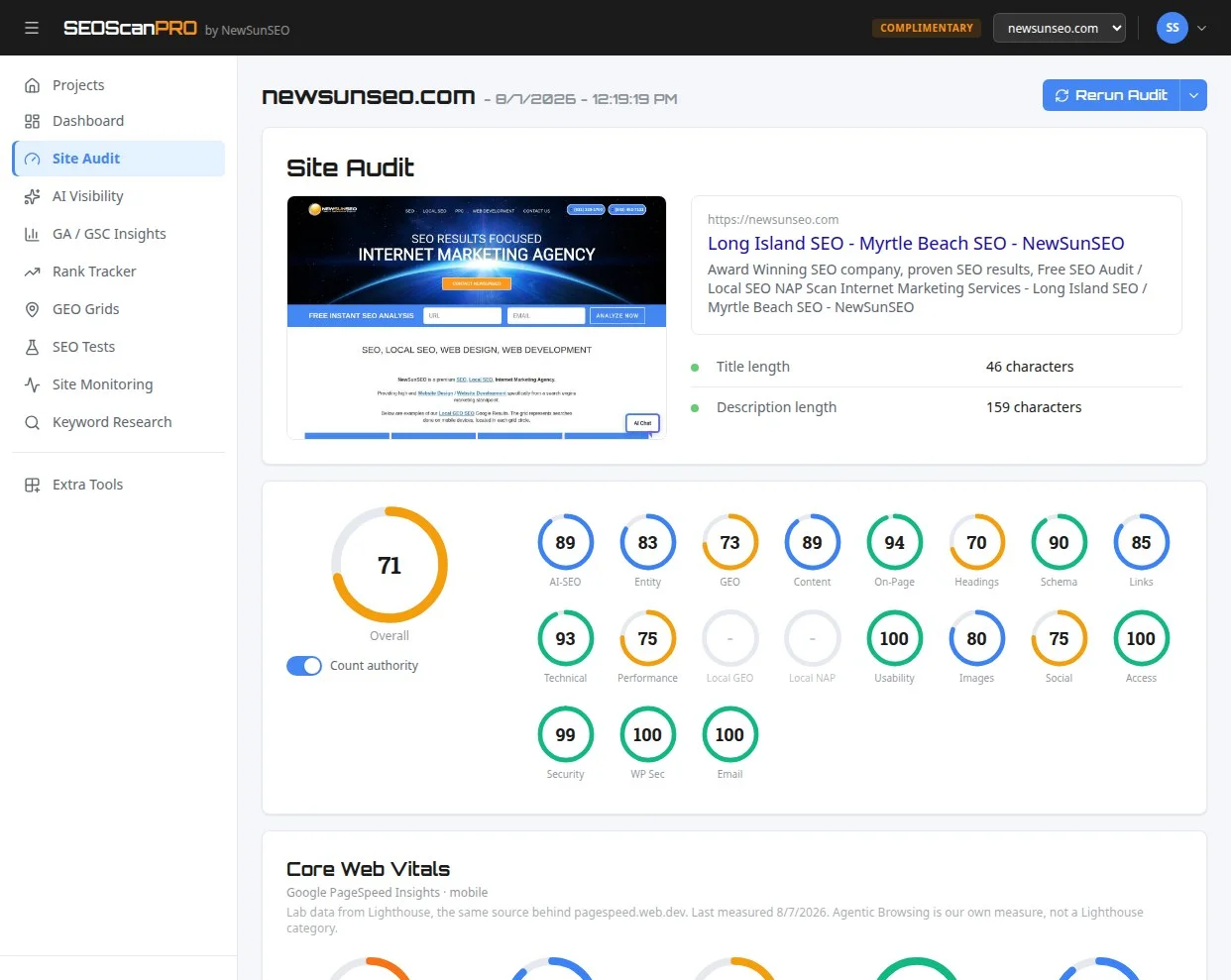
The SEOScanPro site audit tool runs a full technical audit of a site and shows the measured result behind every check. Open the site audit tool.
This article summarizes reporting from seroundtable.com. See our editorial disclaimer for how our articles are produced.
Run a free scan to see your AI Visibility Score, SEO rating, and local citation accuracy.