
Programmatic SEO is a way to publish large volumes of keyword-targeted pages from one template, then scale that template to every relevant variation a searcher might type. The pattern only works after proof that one page actually ranks, that the template can be repeated cleanly, and that there is enough real search demand behind each generated URL to justify the build.
What programmatic SEO is in practice
Programmatic SEO uses a single template, a structured dataset, and an internal linking pattern to publish hundreds or thousands of pages at once. Each page targets a unique head term plus modifier, such as a city plus service, a brand plus attribute, or a product plus specification. The template handles layout, schema, headings and metadata, while the dataset supplies the variable fields.
The point of going programmatic is reach: instead of writing one page per query, a publisher covers the full long tail with consistent quality and structure. Done well, it turns a static site into a generator of useful, intent-matching pages.
Why proof comes before scale
Scaling before proving the pattern is the most common failure in programmatic SEO. A template that has never ranked one page is not ready to publish ten thousand of them, and a dataset full of empty or duplicated fields will produce thin pages at every URL.
Proof has three parts:
- One page, built from the template, ranking on page one for its target query.
- One dataset row, fully populated, repeatable across thousands of entries.
- One set of internal links, pointing cleanly from hub pages to generated pages without loops or orphans.
Once those three checks pass, the template is safe to scale. If any one of them fails, scaling multiplies the failure.
How to validate the pattern on a small batch
The safest validation is a small batch of 20 to 50 pages built from the real template and the real dataset. Each page should use production-quality copy, not lorem ipsum, and should link into the site the same way the full rollout will.
Measure three things before scaling:
- Indexing rate. What share of the batch gets crawled and indexed within four to six weeks?
- Ranking distribution. How many URLs appear in the top 10, top 20, or top 50 for their target query?
- Engagement signals. Do indexed pages earn clicks, dwell time, and any conversions?
If the batch underperforms on any of these, fix the template, the data, or the internal linking before adding more URLs.
Demand checks that prevent thin pages
Programmatic SEO fails fastest when pages target queries nobody searches. A keyword study across the full dataset, not just a sample, is the only reliable check.
Three filters separate useful pages from waste:
- Real search volume. Every generated query needs measurable monthly demand, even if small.
- Clear intent match. The template must satisfy what the searcher wants, whether that is information, comparison, or a transaction.
- Unique value per page. Each generated page should add something a competitor does not, such as proprietary data, original commentary, or a tool the searcher can use.
Filtering the dataset on these three rules before generation keeps thin pages out of the index.
Operational checks that keep the rollout clean
Once the batch proves out, the operational work is keeping the template and the dataset in sync at scale. A generated page with a broken data field, a missing schema block, or a duplicate title is worse than no page at all.
- Schema validation. Run every generated URL through structured data testing to confirm the template renders correctly each time.
- Canonical and pagination hygiene. Decide whether generated pages are canonical to a hub or self-canonical, and apply it consistently.
- Internal linking rules. Codify the link graph so new pages join the site cleanly, and audit it after each rollout wave.
SEOScanPro’s comprehensive website SEO audits include a check of template-rendered pages, which makes it easier to confirm a programmatic rollout holds together at scale.
FAQ
What is programmatic SEO?
Programmatic SEO is the practice of using one content template plus a structured dataset to publish large numbers of keyword-targeted pages, each aimed at a specific long-tail query such as a city plus service or a product plus attribute.
Why do programmatic SEO pages fail to rank?
The most common reasons are a template that has not been proven on a single page, a dataset with empty or duplicated fields, queries with no real search demand, and weak internal linking that leaves generated pages orphaned.
How do you validate a programmatic SEO template before scaling?
Build a small batch of 20 to 50 pages from the real template and dataset, then measure indexing rate, ranking distribution, and engagement signals before publishing the full rollout.
SEOScanPro
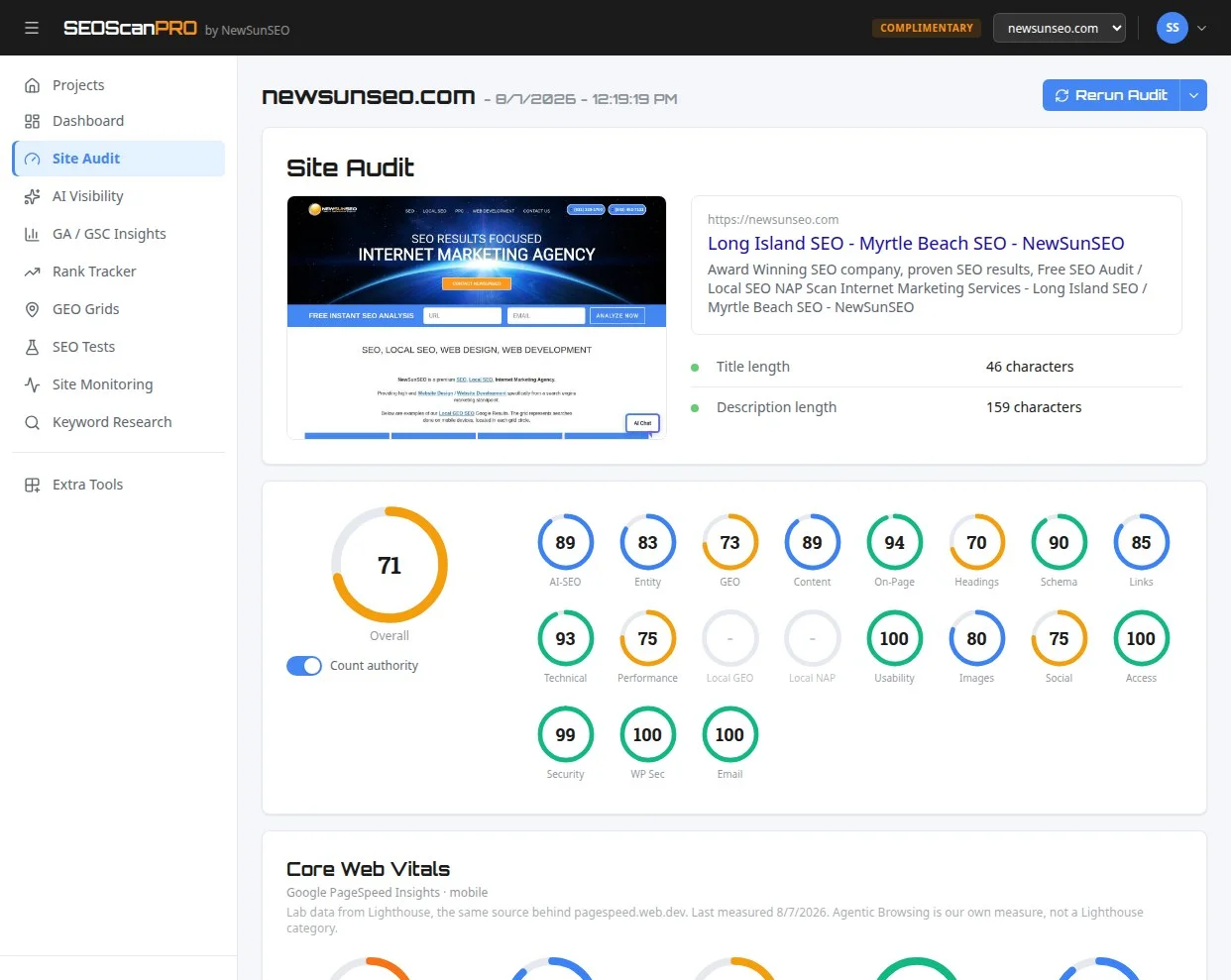
SEOScanPro has the site audit tool runs a full technical audit of a site and shows the measured result behind every check. Open the site audit tool.
This article summarizes reporting from searchengineland.com. See our editorial disclaimer for how our articles are produced.
Run a free scan to see your AI Visibility Score, SEO rating, and local citation accuracy.