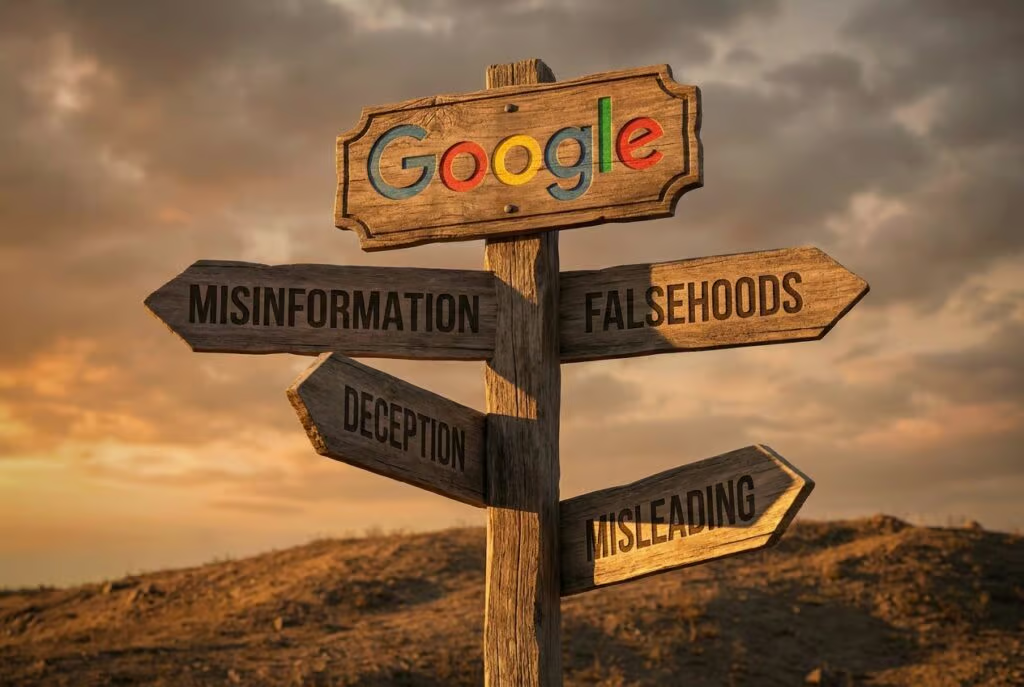
The Munich Regional Court issued a preliminary injunction in June 2026 holding Google liable for false and defamatory claims its AI Overviews generated about two German publishers. The ruling is the first to treat an AI firm’s summaries as the company’s own speech, forcing Google to correct fabricated statements. It could reshape liability for AI search summaries across Europe and beyond.
Why It Matters
AI-generated search summaries have become a primary way people find information. Google’s AI Overviews, Microsoft’s Copilot summaries, and embedded answers in ChatGPT or Perplexity now sit at the front door of the internet. A 2024 Pew Research Center survey found that 61% of Americans who regularly use AI-powered search rarely or never click through to source links. That means what the AI says about your business, its hours, services, and reputation, often becomes the final answer. When the AI gets it wrong and nobody checks, the damage is instant and invisible to you.
For small and midsize businesses, the stakes are high. A hallucinated claim that a business is "known for dubious practices" or has "scam-related complaints" can crater leads overnight. Until now, platforms argued that AI outputs were pure speech or disclaimed by accuracy caveats. This ruling flips the script: the AI can be treated as the speaker, and the platform can be forced to correct it.
What’s New / How It Works
The case arose after two German publishers saw Google’s AI Overviews asserting, "Yes, [the publisher] is known for dubious business practices and is often perceived as a scam." Those statements did not appear in any underlying web pages; the AI fabricated them. The publishers sent a cease-and-desist, Google failed to act quickly, and the court issued a temporary injunction blocking further spread of the false claims.
The court’s reasoning broke new legal ground. It drew a line between traditional search results, which list links to third-party content, and AI-generated summaries that create "independent, new, and substantive statements." Because no third party wrote those words, the platform itself became the author. The judges also rejected the argument that users know AI can be wrong. If the tool’s value depends on people trusting it, the court said, then "the utility would be significantly diminished if the AI overview were generally regarded as unreliable." Google cannot market AI Overviews as helpful and then disclaim all responsibility when they cause harm.
The court also noted that AI summaries are "an additional function, one without which the use of the search engine would still be (and is) possible, and without which users are perfectly capable of finding results amidst the ‘flood of data.’" The AI layer is not necessary for search; it is a commercial add-on, and with that add-on comes liability.
The Numbers
- 61% of regular AI search users rarely or never click source links (Pew Research Center, 2024).
- 9% of AI Overviews contain factual errors, and 56% include inaccurate source links, according to a recent independent analysis by The New York Times (May 2025).
- Zero correction was made by Google for months after clear defamation was flagged; the court found the company failed to address false claims even after direct legal notices.
- Stanford’s 2025 AI Index Report notes that the hallucination rate in general-purpose AI models sits between 3% and 10%, with higher error rates in niche or local queries.
"The AI overview contains statements that do not appear in the search results at all, it is an additional function without which users are perfectly capable of finding results."
, Ruling of the Munich Regional Court, June 2026 (translated)
When AI search engines invent facts about your business, you can no longer hold only the source responsible, you can go after the AI itself.
What Comes Next
This is a preliminary injunction, not a final verdict. Google has stated it is "carefully reviewing this decision, which is not yet final," and will likely appeal. The reasoning, that AI-generated statements are commercial speech and not immunized by traditional search protections, could spread rapidly. Similar cases are being prepared in other European jurisdictions, and U.S. courts have been wrestling with Section 230 and AI speech questions for years. A single successful plaintiff in one country can trigger a global recalibration of how AI search engines handle factual accuracy, opt-out requests, and takedown procedures.
For business owners, the practical outcome will be the emergence of "AI correction" workflows, similar to DMCA takedowns but for defamatory or incorrect AI outputs. Platforms may build faster complaint mechanisms and proactive monitoring for high-stakes categories like health advice, financial claims, and local business reputations. The ruling also puts pressure on Google and others to tighten source verification, which means accurate, well-structured business listings become even more powerful as AI learns to pull from trusted directories.
What This Means for You
The German court ruling is a wake-up call to take AI search visibility seriously. If an AI summary can invent a scandal about your company and the platform bears legal risk, the incentives shift toward making those summaries accurate. Start by auditing what AI tools actually say when someone asks about your business. Run the queries your customers would run. If you find incorrect hours, wrong pricing, or fabricated reputation statements, you are losing leads right now.
BizScoreAI exists to solve exactly this problem. Run an AI contactability scan to see how AI search engines represent your business, whether they pull your correct phone number, hours, and services, or whether they fill gaps with hallucinations. Then claim and optimize your business listings across the directories that AI models trust most. Consistent data across the web is the strongest defense against AI fabrication.
User behavior data leaves no room for complacency: the 2026 AI search behavior study showed that 88% of users accept AI Mode results as-is. And as covered in the comparison of AI Mode vs. AI Overviews, different AI surfaces pull from different source sets, so visibility across all of them is required. A single missing citation can mean a ghost reputation in an AI answer.
Social profiles also matter. AI search increasingly ingests social signals to gauge business credibility. A tool like Feedsta.ai keeps social presence active and factually consistent, reducing the chance that an AI model picks up outdated or conflicting information.
The Bigger Picture
No one needs AI to search the web, but billions of people are using it anyway. The Munich court’s decision accepts that reality and insists that the companies building these tools accept the responsibility that comes with it. You cannot afford to ignore what AI says about you, because the legal system is starting to take it as seriously as print or broadcast speech. Businesses that show up accurately in AI answers will be the ones that survive the transition from blue links to black-box answers. Get data straight, monitor what the AI says, and be ready to correct it.
Sources
- Pew Research Center, 2024
- Stanford 2025 AI Index Report
- BizScoreAI, AI Search Behavior Study 2026
- BizScoreAI, AI Mode vs. AI Overviews Study
FAQ
What did the German court rule about Google AI Overviews?
The Munich Regional Court issued a preliminary injunction holding Google liable for false and defamatory statements its AI Overviews generated about two publishers. The court said AI summaries are independent, substantive statements, not passive listings of links, and that Google must correct them.
How often do Google AI Overviews get facts wrong?
An independent analysis by The New York Times in May 2025 found that 9% of AI Overviews contained factual errors and 56% included inaccurate source links. Google has not published systematic accuracy rates, but the court case highlighted false claims that Google failed to correct for months.
What should business owners do if AI search gets their information wrong?
Audit what AI search engines say about your business, update your official website and all structured listings (Google Business Profile, industry directories) so AI models have correct data, and monitor for fabricated reputation claims. Formal AI correction request processes may become available as rulings like the Munich decision expand.
Related coverage
Run a free scan to see your AI Visibility Score, SEO rating, and local citation accuracy.