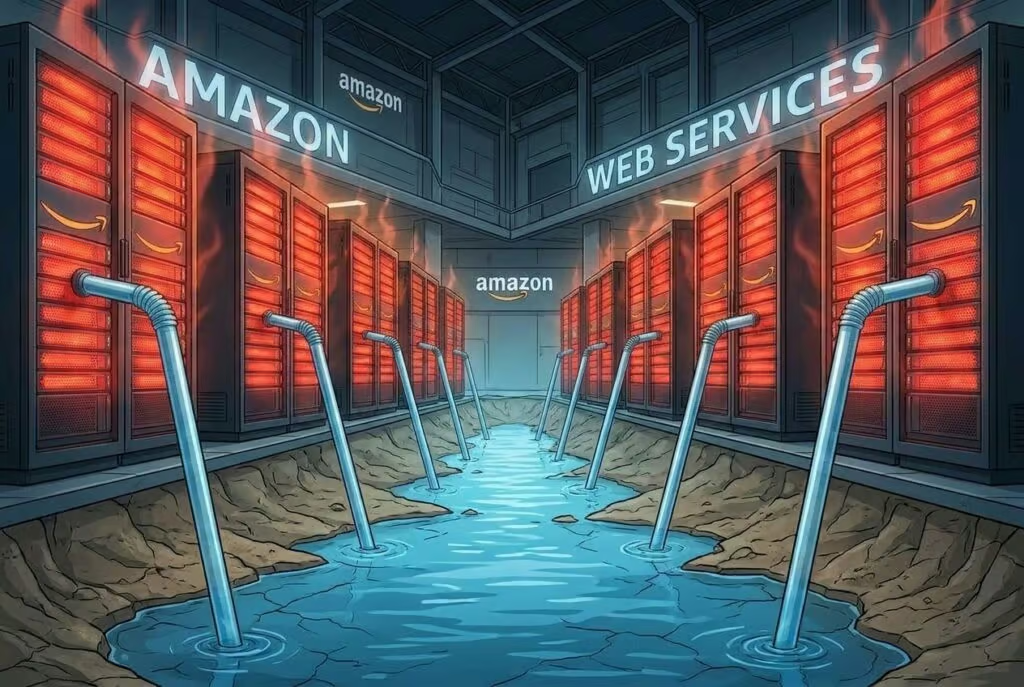
Amazon’s global data centers consumed 2.5 billion gallons of water last year, the company revealed yesterday in its first-ever disclosure. The tech giant immediately framed the number as a win — claiming its facilities are “7x more water-efficient than the industry average” — but the data center water bill behind every AI search, chatbot, and automated lead tool is suddenly a number small business owners can’t afford to ignore.
Why It Matters
Every time a customer asks ChatGPT, Google AI Overviews, or a voice assistant to find a local business, a physical data center somewhere is pulling water to keep its servers cool. The explosion of generative AI has triggered a global buildout of power-hungry infrastructure, and water consumption is now a frontline issue. Nationwide, landscape irrigation alone accounts for roughly 3.3 trillion gallons per year, according to the EPA’s WaterSense data — but the concentrated, year-round draw of data centers is straining water-stressed regions and sparking community pushback.
For small and mid-sized operators, this isn’t a distant sustainability debate. It’s a signal about the resilience, cost, and transparency of the AI platforms you depend on to generate leads and show up in search. When the tools that route customers to your door are built on a resource-intensive backbone, the next service disruption — or price hike — won’t announce itself with a friendly email.
What’s New / How It Works
Amazon’s disclosure, published on its sustainability blog, marks a shift from opaque usage to carefully selected metrics. The company says it relied on utility water meters and third-party auditors to arrive at the 2.5 billion-gallon figure for 2025. It highlighted that 26 data centers already run on 100% reclaimed wastewater — “more than any other cloud provider, with 130 more contracted globally” — and that water-based cooling is used only on the hottest days, with outside air handling most of the load.
Notably, Amazon’s efficiency comparison to Google appears to compare its total data center portfolio against Google’s Gemini-specific AI data centers rather than like-for-like, a detail that has raised eyebrows among watchers tracking the disconnect. The claim that its data centers are 7x more water-efficient than the industry average is also unverifiable absent a public, independent industry benchmark. Amazon’s ultimate goal is to be “water positive by 2030” — returning more water than it consumes in data center operations — and it says it’s already 75% of the way there.
The Numbers
- 2.5 billion gallons — Amazon’s global data center water consumption in 2025 (Amazon sustainability blog).
- 7x — the claimed water-efficiency multiple compared to an unspecified “industry average.”
- 26 facilities already using 100% reclaimed water; 130 more contracted.
- 75% toward “water positive” goal by 2030.
- 3.3 trillion gallons — annual landscape irrigation use in the U.S. (EPA, Outdoor Water Use), or more than 1,300 times Amazon’s data center consumption.
“To put that in perspective, Americans use roughly 3.3 trillion gallons a year to water their lawns and gardens, according to the EPA—meaning every year landscape irrigation uses over 1,300 times more water than our data centers.”
— Amazon sustainability blog
What Comes Next
Amazon’s water-positive target requires scaling reclaimed-water projects globally, and the company is contracting new facilities at a rapid clip. At the same time, the buildout of AI-specific data centers — loaded with water-hungry GPUs — will push total consumption higher regardless of efficiency improvements. Industry watchers expect more public reporting from Microsoft, Google, and others as regulators in water-stressed states demand disclosure. For business owners, the bigger story isn’t one company’s numbers — it’s that the real cost of AI search and automation is still being counted on the backend.
What This Means for You
If your business relies on AI-generated search visibility, chatbot-driven leads, or automated listing platforms, the water data is a proxy for a larger risk: hidden infrastructure fragility. When the services you count on are resource-constrained, your own discoverability can flip overnight. Here’s what you can do right now:
1. Verify your AI-contactability. AI search tools (Google AI Overviews, ChatGPT, Perplexity) are pulling business information from across the web — and they’re only as accurate as your listings. Run a free scan on BizScoreAI’s AI contactability analyzer to see if AI agents can find, understand, and contact your business.
2. Claim and control your business listing. Consistent directory profiles aren’t optional anymore; they’re the bedrock of AI discoverability. Claim your listing and make sure your name, address, and phone number are identical everywhere they appear.
3. Diversify your search presence. As we’ve reported, DuckDuckGo installs jumped 30% as users flee Google’s AI Search, and new behavior studies show AI Mode and AI Overviews drive opposite user journeys. Don’t bank on a single AI surface — spread your footprint.
While you’re tightening your business data, keep your social profiles active and consistent. Feedsta.ai automates social media creation, scheduling, and cross-platform analytics so your brand stays visible wherever customers search — without adding to your team’s workload.
If the platforms that send you leads are running on empty water supplies, your business visibility could be next.
The Bigger Picture
Amazon’s water disclosure isn’t just a sustainability story — it’s a glimpse into the physical infrastructure behind the AI tools every business now depends on. When water use becomes a metric, infrastructure limits become business limits. The operators who audit their AI visibility, verify their listings, and stay platform-agnostic now will be the ones whose phones still ring when the next resource squeeze hits.
Frequently Asked Questions
How much water do data centers really use?
Why should a small business care about AI data center water use?
Is Amazon really 7x more water-efficient than others?
What does ‘water positive’ mean?
Does using AI for search directly waste water?
How can I protect my business from AI infrastructure instability?
Should I stop using AI tools because of their water footprint?
Run a free scan to see your AI Visibility Score, SEO rating, and local citation accuracy.