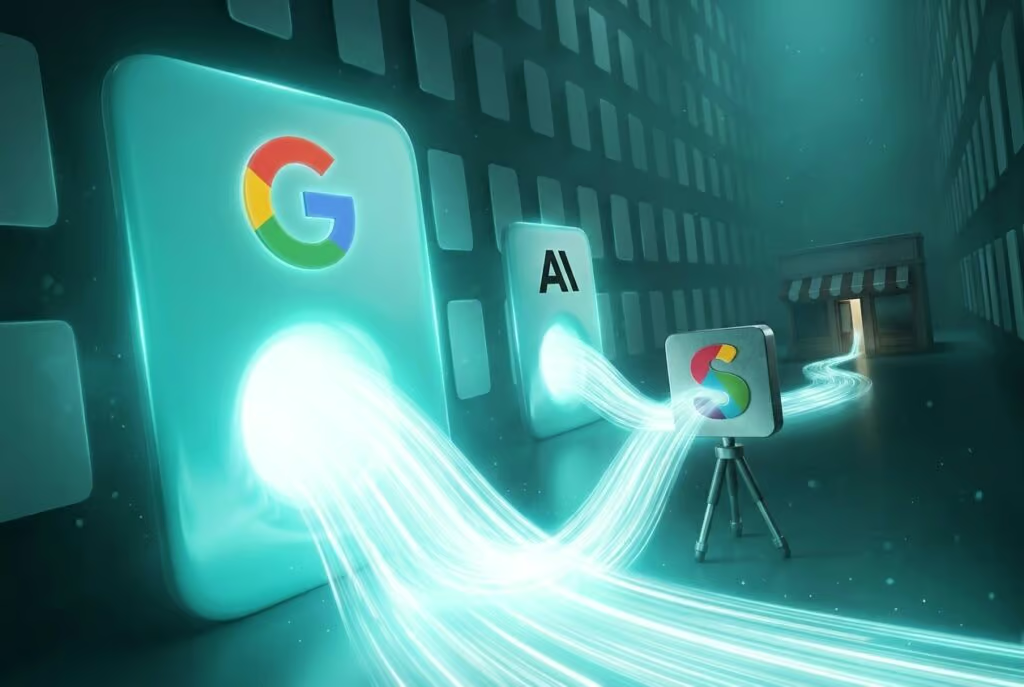
Approximately 68% of Google queries now end without a click to any website, pushed higher by the expansion of AI Overviews and the rollout of AI Mode. For publishers, content marketers, and anyone dependent on organic search traffic, the shift redefines how visibility and revenue are earned in 2026.
When AI answers live on the results page, the click becomes a privilege your content has to earn.
Why It Matters
Zero-click searches are queries that finish without a click to any web property. They happen when Google’s result page satisfies the user with a featured snippet, knowledge panel, instant answer, or, increasingly, an AI-generated overview that synthesizes information from multiple sources.
In 2024, SparkToro’s Zero-Click Search Study found that 65% of searches on U.S. Google didn’t result in a click to an external site (SparkToro, 2024). That was up from roughly 50% in 2019. Since then, Google has expanded AI Overviews across billions of queries and launched AI Mode, an opt-in conversational search layer that answers multi-step questions without leaving the results page. The trajectory is clear: zero-click is becoming the default experience for a growing share of search.
For any publisher that earns revenue through display ads, affiliate links, or lead capture, this trend directly challenges the business model. Content that once drew readers onto a site now gets consumed, if at all, inside Google’s walled garden. Understanding what drives zero-click behavior is the first step toward adapting.
What’s New: AI Overviews and AI Mode
AI Overviews, first tested as Search Generative Experience, now appear for a wide range of informational, commercial, and local queries. When a user types a question, Google’s Gemini model pulls from multiple pages and generates a snapshot answer at the top of the results. Users often get the information they need without scrolling or clicking.
AI Mode, introduced as an experimental feature in early 2026, takes this further. It turns the search results page into a persistent AI conversation. Users can ask follow-up questions, request comparisons, or ask the AI to draft a plan, all inside a chat-like interface that sits on top of the traditional links. In AI Mode, the ten blue links are effectively replaced by a continuous AI-generated answer stream (Google).
Both features are optimized for task completion, not referral traffic. The AI retrieves, synthesizes, and answers. The source pages that contributed to the answer may appear as a small carousel or a "learn more" link, but the click-through is secondary. This architecture has fundamentally altered the relationship between content creators and the search engine that used to be their largest traffic source.
The result: a steady climb in the zero-click share, from 65% in early 2024 to an estimated 68% by mid-2026 as AI Overviews roll out to more markets and query types.
The Numbers
- 65% of US Google searches ended without a click in SparkToro’s 2024 study.
- ~68% estimated zero-click rate in 2026 as AI Overviews and AI Mode expand.
- AI Overviews are now present on hundreds of millions of queries daily across 100+ countries, according to Google.
- In AI Mode, external clicks become secondary interactions; citations are often tucked behind expandable source lists.
“For the first time in our tracking, the majority of Google searches now end without a click.”
What Comes Next
Google has signaled that AI Mode will graduate from experiment to a persistent feature, and AI Overviews will appear for more complex, multi-turn queries. As these capabilities deepen, the clickable web will shrink further. Publishers will need to monitor new performance indicators, AI citation visibility, share of AI voice, and sentiment inside AI-generated summaries, in addition to traditional rankings and click-through rates.
Google’s Search Console now includes AI Search reports that show whether a site’s pages are cited in AI Overviews. Early adopters are already using that data to understand which content formats and structures win citations. The next evolution will likely bring metrics around AI Mode interactions, giving site owners a window into how their content is used inside the conversation layer.
Regulatory discussions in the EU and US about AI-generated content attribution and fair compensation for publishers are also accelerating. Any mandate to display prominent source links or share revenue could reshape the zero-click curve, but for now the trend is firmly upward.
What This Means for You
If your revenue depends on search traffic, the 68% figure isn’t a reason to abandon SEO, it’s a call to evolve it. The playbook is shifting from "rank and get clicks" to "earn citations in AI answers and make your brand the reason users show up directly."
Here are four strategic pivots that publishers are making right now:
- Answer-engine optimization (AEO). Structure your content to be the most accurate, complete, and well-formatted source for the queries AI Overviews pull from. Use concise sections, direct answers in the first paragraph, and explicit entity markup. Our deep-dive on the 2026 AEO & GEO content framework walks through how to prioritize updates versus new content for AI citations.
- Conversational content. AI Mode favors content that answers natural-language questions and follow-ups. Create FAQ hubs, comparison guides, and how-to sequences that mirror the user’s actual conversation path.
- Brand-in-the-answer strength. Even when users don’t click, they remember a brand that appeared in the AI snapshot. Optimize your author entity, publish unique data, and build citation-worthy trust signals so your name inside the answer drives direct traffic later.
- Diversify distribution. Reduce dependence on a single search channel by building email lists, community platforms, and presence in other AI-driven surfaces like ChatGPT, Perplexity, and Gemini’s own ecosystem. The portfolio approach protects against any one algorithm shift.
For more on how Google’s AI-first search box is changing the game, see our breakdown of Google I/O 2026 AI Search upgrades. And for ongoing strategy as these changes unfold, browse the latest at BizScoreAI’s blog.
The Bigger Picture
Zero-click isn’t a traffic apocalypse, it’s a redefinition of the publisher’s role. The sites that thrive will be those that adapt to answer-engine optimization, earn citations in AI-generated answers, and build brand affinity strong enough that users seek them out even after seeing a snippet. Search engines are becoming answer engines, and the content strategy rulebook is being rewritten in real time. Those who write the new rules will own the next decade of digital visibility.
FAQ
What percentage of Google searches are zero-click in 2026?
Approximately 68% of Google searches are estimated to end without a click in 2026, up from 65% in 2024 according to SparkToro. The rise is driven by the expansion of AI Overviews and AI Mode, which answer queries directly on the results page.
What causes a zero-click search?
A zero-click search happens when the search results page fully answers the user’s query through a featured snippet, knowledge panel, instant answer, calculator, map pack, or AI Overview, removing the need to click through to any website.
How can publishers adapt when zero-click searches dominate?
Publishers are shifting to answer-engine optimization (AEO), building conversational content for AI Mode, strengthening brand presence inside AI answers, and diversifying distribution across email, community platforms, and other AI surfaces like ChatGPT, Perplexity, and Gemini. Monitoring AI Search reports in Google Search Console also helps track citation visibility.
Run a free scan to see your AI Visibility Score, SEO rating, and local citation accuracy.