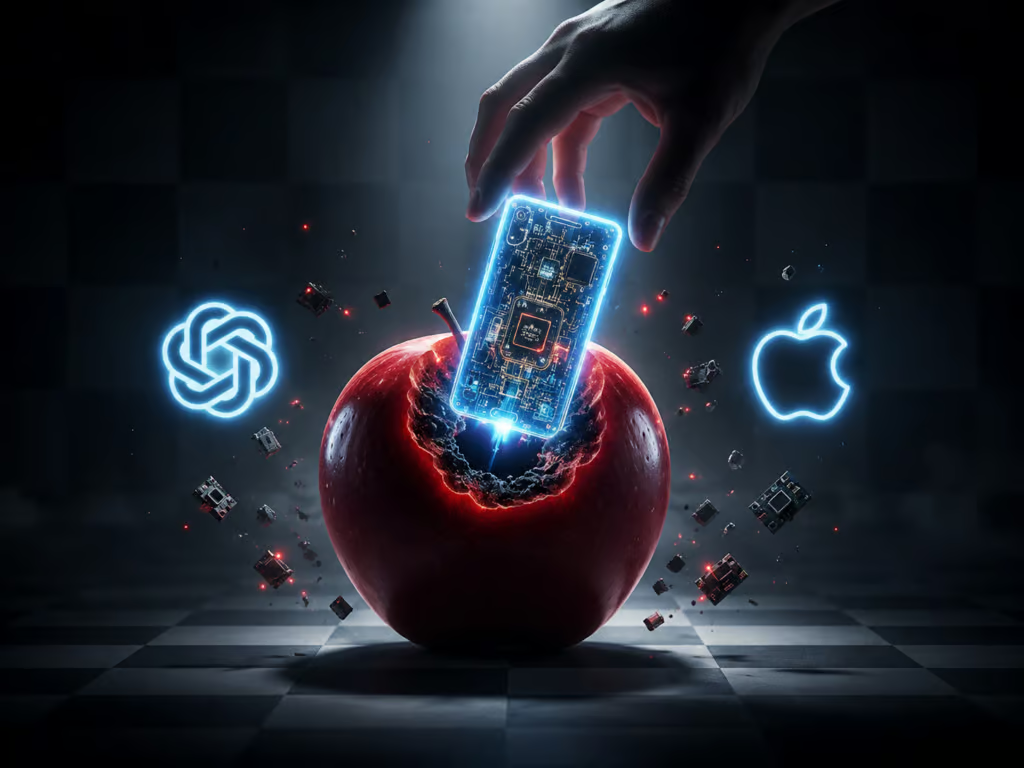
Apple filed a lawsuit on July 10, 2026, in the U.S. District Court for the Northern District of California, accusing OpenAI of orchestrating a coordinated campaign to steal trade secrets and confidential information related to Apple’s hardware development. The complaint alleges the theft occurred “at every level” of OpenAI, including members of its technical staff and hardware leadership, and names OpenAI, its hardware chief Tang Tan, former Apple employee Chang Liu, and IO Products as defendants.
What does Apple’s lawsuit allege?
An Apple representative stated that “significant evidence has emerged suggesting individuals employed by OpenAI wrongfully took Apple’s secret and confidential information.” The suit names OpenAI, its hardware chief Tang Tan, former Apple employee Chang Liu, and IO Products, the startup acquired by OpenAI for $6.4 billion, as defendants.
How did the Apple-OpenAI relationship shift from partnership to rivalry?
Relations between Apple and OpenAI deteriorated sharply after a high-profile 2024 partnership that integrated ChatGPT into Apple’s smartphone operating system. OpenAI CEO Sam Altman visited Apple’s headquarters for the announcement. Tensions escalated after OpenAI announced plans to enter the hardware industry and acquired IO Products, a startup founded by former Apple designer Jony Ive, for $6.4 billion. Apple’s updated Siri assistant now runs on Google’s Gemini AI models rather than OpenAI technology. The legal filing frames this arc as a shift from collaboration to direct competition, with Apple alleging that OpenAI used the partnership as cover to extract proprietary information.
What specific conduct does Apple describe?
The complaint details a months-long scheme involving former Apple employees now at OpenAI. Apple alleges that Tang Tan, a former Apple vice president who now leads hardware at OpenAI, directed Apple job candidates to bring “actual parts” from Apple to their interviews for “show and tell” sessions. The suit claims OpenAI coached departing employees on how to evade Apple’s security processes. Former employee Chang Liu is accused of stealing an Apple laptop.
Apple further alleges that OpenAI asked hardware firms to use a proprietary metal finishing technique while misleading partners into believing they had Apple’s permission to do so. The company described the alleged scheme as “rotten to its core.”
How has OpenAI responded?
A representative for OpenAI denied the allegations, stating: “We have no interest in other companies’ trade secrets. We remain focused on building innovative technology that empowers people everywhere.” The lawsuit arrives as OpenAI prepares for a historic initial public offering and roughly two months after the company won a federal trial against Elon Musk over similar claims. Altman said in November 2025 that OpenAI had completed its first hardware prototypes.
The case highlights broader risks in the AI sector, where rising valuations and intense competition have fueled concerns about an investment bubble.
What legal remedies is Apple seeking?
Apple is seeking damages, injunctions, and an order requiring OpenAI to stop using the alleged trade secrets. The company did not comment on whether the lawsuit will affect its existing partnership with OpenAI, which includes ChatGPT integration into Apple Intelligence. The outcome could set a precedent for trade secret protection in the AI hardware market.
FAQ
When did Apple file the lawsuit against OpenAI?
Apple filed the lawsuit on July 10, 2026, in the U.S. District Court for the Northern District of California.
Who are the named defendants in the case?
The defendants are OpenAI, its hardware chief Tang Tan, former Apple employee Chang Liu, and IO Products, the startup acquired by OpenAI for $6.4 billion.
What does Apple want the court to do?
Apple is seeking damages, injunctions, and an order requiring OpenAI to stop using the alleged trade secrets.
Related coverage
Run a free scan to see your AI Visibility Score, SEO rating, and local citation accuracy.