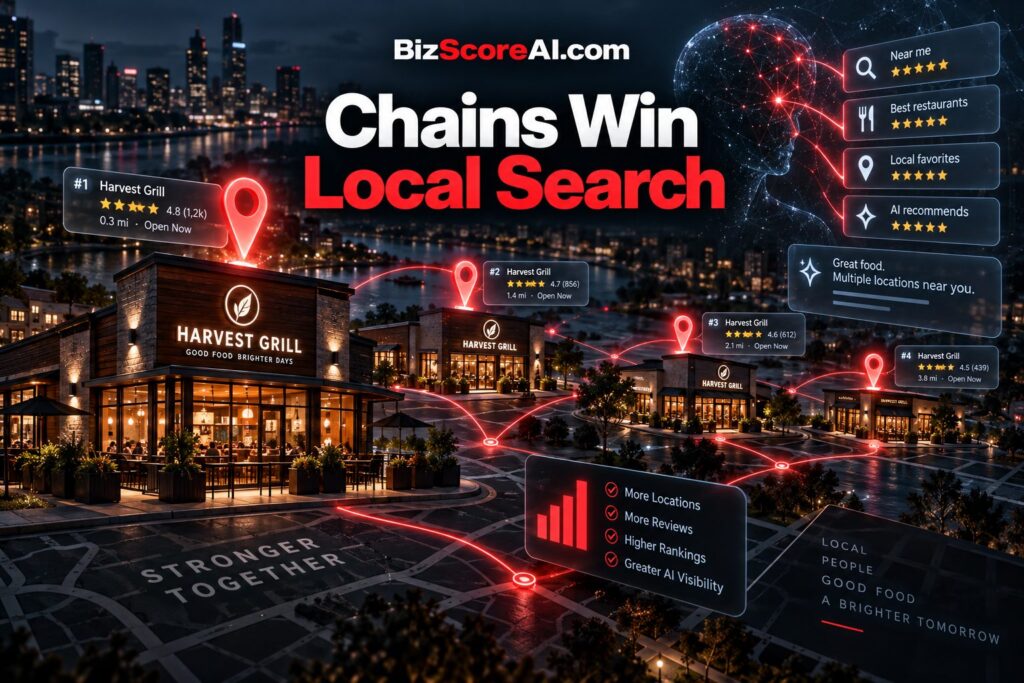
Growing restaurant chains take a larger share of local search results and AI answers than independent restaurants, because every new location adds another perfectly aligned listing, another batch of citations, and another pocket of brand trust to a network that compounds with scale. The independent operator next door usually carries one storefront, one Google Business Profile, and whatever reviews happen to show up. The chain has a playbook, a system, and dozens of locations all reinforcing the same brand.
What “winning at local search” actually looks like
Local search rewards businesses that Google can verify, trust, and place on a map with confidence. Three signals carry most of the weight:
- Consistent business information across the web: name, address, phone number, hours, and category.
- A steady flow of reviews on Google and other platforms, with replies from the owner.
- Local links and citations from directories, food publications, news sites, and community pages.
Chains are built to produce these signals by default. Every store opens with a verified profile, identical NAP data, and a regional marketing team that runs review-ask campaigns and pitches local press. A single-location owner has to do all of that work by hand, often on nights and weekends.
Why AI answers favor chains
When someone asks an AI assistant “what’s the best pizza near me,” the model is leaning on the same signals search engines trust, plus a few it adds for itself:
- Brand mentions across the web, even without a link.
- Structured data on the restaurant’s own website, including schema for menus, locations, and hours.
- Consistent entity information across Wikipedia, Wikidata, review sites, and social profiles.
- Volume of location-specific pages that clearly answer a real question.
A chain with 200 locations has 200 location pages, 200 Google Business Profiles, and a brand that shows up in “best of” lists in dozens of cities. An independent restaurant has one page and one profile. The AI sees a chain as a verified entity it can recommend with confidence. The independent looks like a single data point it cannot confirm as easily.
The compounding effect of opening new locations
Every new restaurant a chain opens adds to a few piles at once:
- More reviews, which raise average rating confidence for the brand.
- More citations, which strengthen the brand entity in Google’s knowledge graph.
- More local pages, which give crawlers more entry points into the brand’s site.
- More press mentions at openings, which feed AI models fresh, attributable signals.
For an independent, the opposite is true. There is no next location. The work of building a single entity, earning the first 100 reviews, and getting into local publications has to be repeated at full intensity for that one address. Growth is a moat for chains and a tax for independents.
What independents can borrow from the chain playbook
The independent operator cannot open 40 stores, but most of the chain advantages come from process, not headcount. A solo owner can adopt the same habits:
- Treat the Google Business Profile like a second website. Update it every week with photos, posts, and accurate hours.
- Standardize NAP data across every directory the business appears in. Inconsistencies split trust.
- Ask every regular for a review, and reply to every review, positive or negative.
- Add LocalBusiness and Restaurant schema to the site so AI models can read hours, menu, and location cleanly.
- Pitch local food writers and neighborhood blogs. A handful of strong mentions does more than a thousand weak ones.
None of this scales a single restaurant into a chain. It does close a real share of the visibility gap, which is what shows up in map packs and AI answers.
Where tooling helps
Tracking how a business appears across a service area, not just one city average, is the kind of work that benefits from automation. A rank tracker that pulls results for a restaurant’s actual trade area surfaces the towns and suburbs where the listing is invisible. A local SEO audit catches inconsistent NAP data, missing schema, and weak review velocity before they cost rankings. For a chain, those checks run across hundreds of locations. For an independent, they run once a month and pay off in the next map pack update.
FAQ
Why do restaurant chains rank better in local search than independent restaurants?
Chains produce more verified signals by default: consistent business information across directories, a steady flow of reviews, and structured location pages. Each new store adds more citations and brand mentions, which compounds the brand’s authority in Google’s knowledge graph and in the answers AI models draw from.
How do AI search engines choose which restaurants to recommend?
AI assistants lean on brand mentions, structured data on the restaurant’s website, consistent entity information across the web, and a high volume of location-specific pages that clearly answer real questions. Brands with strong, consistent signals across all four are easier for a model to recommend with confidence.
Can a single-location restaurant compete with a chain in local search and AI answers?
It cannot match a chain’s scale, but it can copy the chain’s process: keep the Google Business Profile active, standardize NAP data across directories, earn reviews consistently, add Restaurant and LocalBusiness schema to the site, and pitch neighborhood writers for brand mentions. Process beats headcount over time.
Related coverage
- How All-Caps Title Tags Affect Local Search Rankings – BizScoreAI
- Google’s New AI Search Box, Local Sponsorships and Review ROI – BizScoreAI
- Creator Content in AI Search Visibility Strategy
Try the AI visibility scan
The AI visibility scan scores how visible a business is to AI search and shows what its listing looks like to the engines people ask. Open the AI visibility scan.
This article summarizes reporting from searchengineland.com. See our editorial disclaimer for how our articles are produced.
Run a free scan to see your AI Visibility Score, SEO rating, and local citation accuracy.