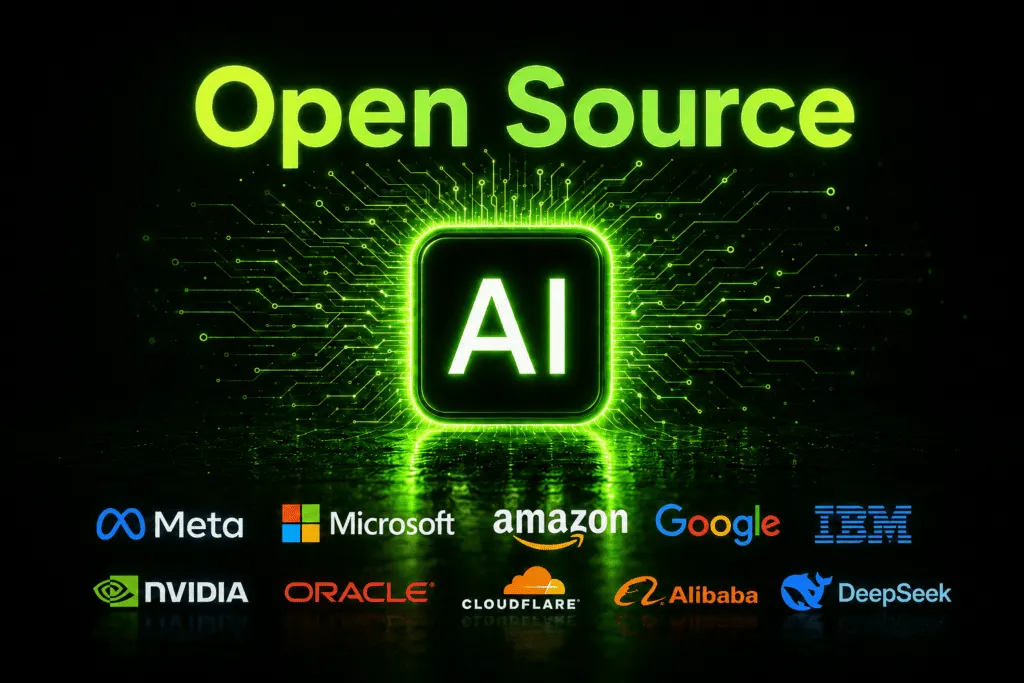
On July 24, 2026, Nvidia, Microsoft, Meta, and 47 other technology companies, venture-capital firms, and nonprofits signed an open letter titled “Open Weights and American AI Leadership,” urging Washington not to restrict open-weight AI models and arguing that open weights are central to U.S. AI leadership.
Who signed the letter and how it grew
Nvidia CEO Jensen Huang first shared the letter in his first post on X, with 25 initial signatories. A few notable names were absent from that first wave, including OpenAI. Within a day, support widened and the number of signatories doubled as OpenAI, Google, AMD, Cisco, and others joined. Anthropic did not sign.
What does the letter argue about open-weight AI?
The letter defines open-weight models as AI models that anyone can download, inspect, modify, and run on their own infrastructure. It makes several specific claims about why restricting these models would hurt American interests:
- Open weights expand access to the AI economy, letting startups, businesses, universities, and public institutions build on advanced models without training a model from scratch, without paying frontier-model prices for every use, and without relying on one model for every job.
- Open weights let developers copy and modify models, which lowers barriers to entry and puts pressure on prices across model developers, cloud providers, chip makers, applications, and services.
- Open weights let customers run, modify, and host the models on their own infrastructure, which can help avoid vendor lock-in.
How does the letter address safety and security risks?
The letter says open weights carry risks, noting that released weights cannot be controlled by the original developer and that modified versions can be difficult to trace. According to the letter, prohibition is not the answer. Attackers already use advanced AI, so defenders need models with comparable capabilities, and open models let many teams find and fix vulnerabilities.
The letter adds that openness may be one of the most important paths to AI safety and security, because closed models are not inherently safe and restricting access to advanced capabilities to a few closed models creates single points of failure.
What specific policies are the signatories asking for?
The signatories outline three concrete policy requests. First, expand access to compute for startups and researchers. Second, invest in shared training assets such as datasets, tools, and evaluation frameworks. Third, keep the frontier plural by avoiding premature restrictions that stifle competition or drive innovation overseas.
The letter also warns policymakers not to conflate legitimate model-development techniques with misappropriation, stating that distillation, the practice of using one model’s outputs to train another, should not be confused with misappropriation.
Why does this letter matter now?
The letter arrives amid accusations that Chinese labs extracted intelligence from U.S. models, including Anthropic’s Fable. Washington’s response remains unclear. Anthropic is the lone U.S. frontier lab not on the list of signatories.
The full letter is available as a PDF on Nvidia’s site at images.nvidia.com.
FAQ
What is the “Open Weights and American AI Leadership” letter?
It is an open letter signed by Nvidia, Microsoft, Meta, and 47 other technology companies, venture-capital firms, and nonprofits, published on July 24, 2026, urging Washington not to restrict open-weight AI models.
Which companies signed the letter, and who did not?
The letter launched with 25 signatories, with Nvidia CEO Jensen Huang sharing it on X. Within a day, support doubled to include OpenAI, Google, AMD, Cisco, and others. Anthropic did not sign.
Why do the signatories want open-weight AI to remain unrestricted?
They argue open-weight models can expand access to the AI economy, strengthen competition, avoid vendor lock-in, and may be one of the most important paths to AI safety and security, while warning that restricting them would drive innovation overseas.
Related coverage
- Poolside releases Laguna S 2.1, an open-weight coding model that beats rivals 10x its size
- Introducing Antares: Highly Efficient Open-Weight AI Models for Vulnerability Localization
Related coverage
- Poolside releases Laguna S 2.1, an open-weight coding model that beats rivals 10x its size
- Introducing Antares: Highly Efficient Open-Weight AI Models for Vulnerability Localization
See our editorial disclaimer for how our articles are produced.
Run a free scan to see your AI Visibility Score, SEO rating, and local citation accuracy.