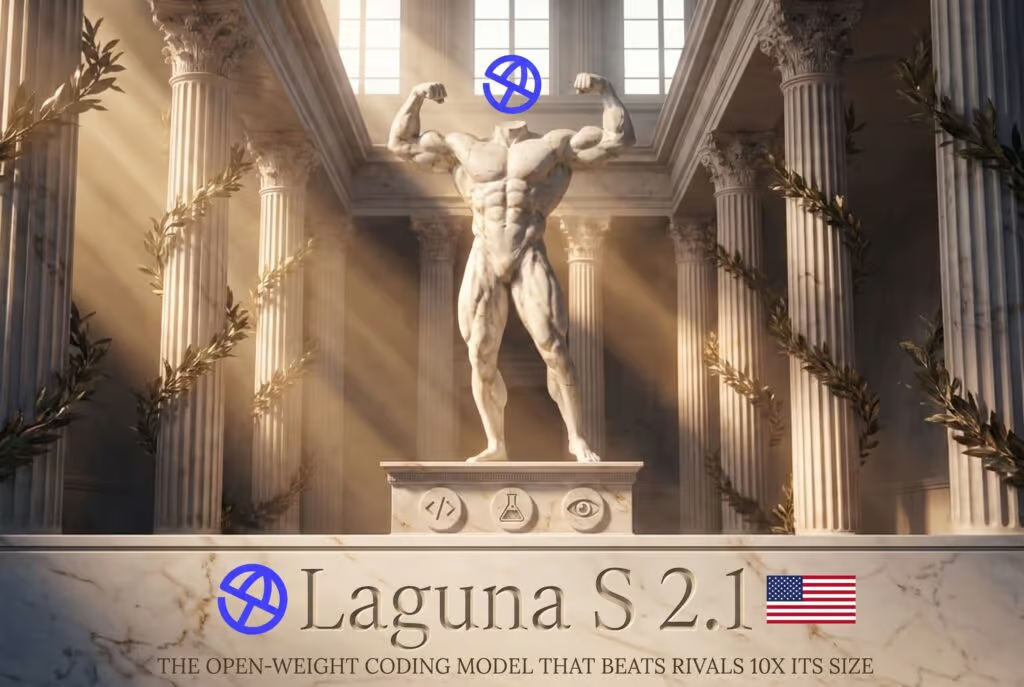
Poolside, the San Francisco AI lab known for selling coding models to governments and defense agencies, released Laguna S 2.1 on Tuesday, July 21, 2026. The new model is a 118-billion-parameter Mixture-of-Experts (MoE) coding model that activates only 8 billion parameters per token, and its weights are available immediately on Hugging Face under the permissive OpenMDW-1.1 license. Poolside positions the release as a Western, openly licensed alternative to a field it says has been dominated by Chinese open-weight labs.
What Laguna S 2.1 is and how it is built
Laguna S 2.1 is a sparse Mixture-of-Experts model with 256 routed experts plus one shared expert. It uses grouped-query attention and interleaved sliding-window layers, and it supports a context window of up to 1 million tokens. Because only 8 billion parameters activate per token, inference costs scale with that smaller active footprint. Poolside says the model is small enough to run on a single Nvidia DGX Spark.
Pre-training began on May 22, 2026, and the model launched in under nine weeks. Training was conducted on 4,096 Nvidia H200 GPUs, and the release marks Poolside’s third shipped model in three months.
Benchmark performance against much larger models
On Terminal-Bench 2.1, a benchmark for long-horizon terminal tasks, Laguna S 2.1 scores 70.2 percent, placing 11th on Poolside’s compiled leaderboard. That puts it ahead of DeepSeek-V4-Pro-Max, a 1.6-trillion-parameter model that scored 64.0, Thinking Machines Inkling at 975 billion parameters and 63.8, and Nvidia Nemotron 3 Ultra at 550 billion parameters and 56.4.
On SWE-Bench Multilingual, Laguna S 2.1 posts 78.5 percent, and on the SWE-Bench Pro public dataset it reaches 59.4 percent. On its hardest benchmark with thinking mode enabled, the model consumes roughly 249,000 completion tokens per trajectory.
Why Poolside is releasing open weights now
Poolside frames the launch as a direct response to the dominance of Chinese open-weight labs, naming DeepSeek, Qwen, Kimi, GLM, MiniMax, and Tencent Hunyuan as the competitors it is countering. The company notes that Laguna S 2.1 occupies a size class into which no Western lab has released open weights in 11 months, since OpenAI’s gpt-oss-120b last August.
Co-CEO Jason Warner tied the strategy to sovereignty concerns, stating that the West needs open-weight models it can trust, run, and build on. Co-founder and co-CEO Eiso Kant was more direct on X, writing that he believes intelligence should and will become a commodity.
What developers and buyers get
Open weights on Hugging Face under the OpenMDW-1.1 license allow anyone to download, run, and fine-tune the model without negotiation, subject to the license’s terms. Because the active parameter count is 8 billion rather than the full 118 billion, Poolside argues that organizations can serve it on far less hardware than the larger models it outperforms on coding tasks.
Poolside has historically focused on government and defense customers, and Laguna S 2.1 is consistent with that strategy: a coding model that sovereign customers can self-host, audit, and modify on their own infrastructure.
FAQ
What is Laguna S 2.1?
Laguna S 2.1 is a 118-billion-parameter Mixture-of-Experts coding model released by Poolside on July 21, 2026. It activates 8 billion parameters per token, supports a 1 million-token context window, and is available on Hugging Face under the OpenMDW-1.1 license.
How does Laguna S 2.1 compare to larger models on coding benchmarks?
On Terminal-Bench 2.1 it scores 70.2 percent, ahead of DeepSeek-V4-Pro-Max at 64.0, Thinking Machines Inkling at 63.8, and Nvidia Nemotron 3 Ultra at 56.4. It also posts 78.5 percent on SWE-Bench Multilingual and 59.4 percent on SWE-Bench Pro.
Why is Poolside releasing an open-weight coding model?
Poolside says the release responds to the dominance of Chinese open-weight labs such as DeepSeek, Qwen, Kimi, GLM, MiniMax, and Tencent Hunyuan, and fills a gap left by Western labs, which have not released open weights in this size class since OpenAI’s gpt-oss-120b in August of the prior year. Co-CEO Jason Warner said the West needs open-weight models it can trust, run, and build on.
Related coverage
- Moonshot AI’s Kimi K3 Beats Opus 4.8 as the Largest Open Model Ever
- Introducing Antares: Highly Efficient Open-Weight AI Models for Vulnerability Localization
See our editorial disclaimer for how our articles are produced.
Run a free scan to see your AI Visibility Score, SEO rating, and local citation accuracy.