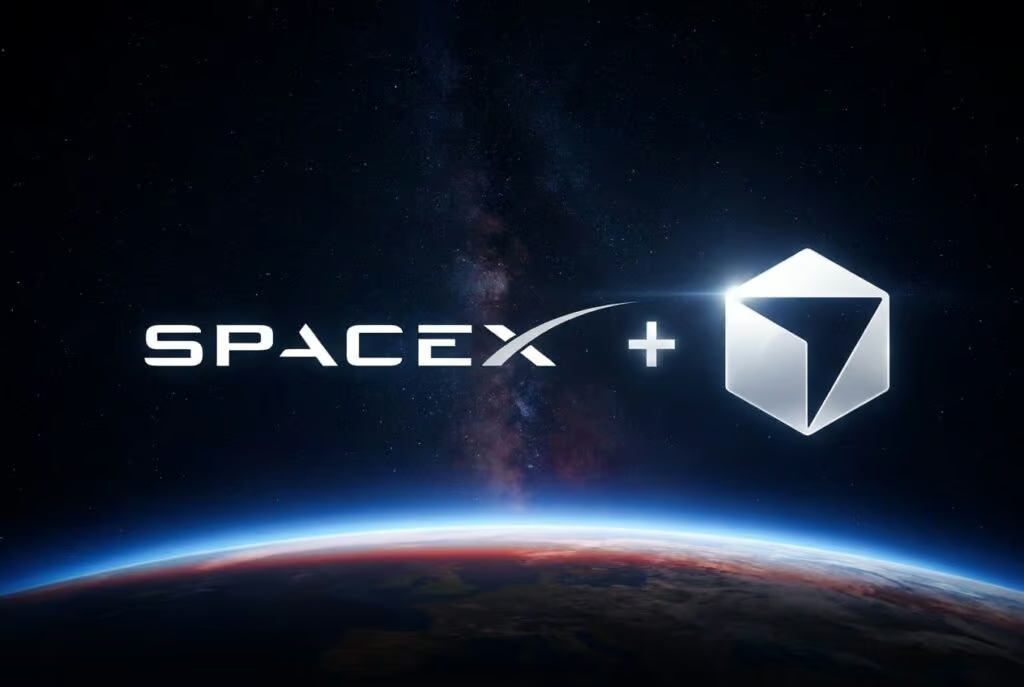
SpaceX will acquire Cursor, the AI coding assistant, in an all-stock deal valued at $60 billion, the aerospace and technology firm announced Tuesday. The deal accelerates SpaceX’s entry into the developer-tools market for large language models and pairs Cursor’s model-building team with the compute of SpaceX’s Colossus supercomputer. For a startup hitting a compute ceiling on its Composer coding models, the merger functions as a hardware unlock.
Why Does This Deal Matter?
AI coding assistants are no longer a niche productivity hack. They are the primary on-ramp for millions of developers interacting with frontier models every day. OpenAI’s Codex, Anthropic’s Claude Code, and GitHub Copilot have carved out loyal followings, while Elon Musk’s xAI has so far lacked a competitive answer in the coding category. Cursor, founded in 2022, quickly became a darling of the developer community, crossing $1 billion in annualized revenue by November 2025 and earning a spot on the CNBC Disruptor 50 list. Behind that momentum, the startup’s model releases were repeatedly constrained by compute availability, a ceiling that SpaceX’s infrastructure can demolish overnight.
How Does the Deal Work?
The agreement formalizes an option SpaceX secured in April, giving it the right to acquire Cursor for $60 billion. The transaction is entirely stock-based, representing roughly 3.4% dilution against SpaceX’s valuation at the time of its public debut. If the merger fails to close, SpaceX has committed to a $1.5 billion termination fee plus $8.5 billion in computing resources. Cursor CEO Michael Truell described the partnership as "a meaningful step on our path to build the best place to code with AI." His team will now work alongside SpaceX engineers to scale Composer, the startup’s core model for generating and reviewing code, using compute that was previously out of reach. The all-stock structure, the termination provisions, and the speed with which the deal moved from option to signed agreement all point to a deliberate strategy: swap an in-house struggle for a mature product and give it rocket-grade resources overnight.
SpaceX’s $60 billion bet transforms a compute-limited coding startup into a rocket-fueled lab, and reorders the AI developer tool race.
What Are the Key Numbers?
- $60 billion in an all-stock transaction, pricing Cursor as one of the largest AI startup acquisitions ever.
- 3.4% dilution for SpaceX shareholders, based on the public-trading valuation that made SpaceX the fourth most valuable U.S. company.
- $1.5 billion termination fee plus an $8.5 billion compute commitment from SpaceX filings, guaranteeing Cursor a $10 billion floor regardless of deal outcome.
- $1 billion in annualized revenue hit by Cursor only three years after founding, underscoring the product’s adoption velocity.
- Combined Thrive Capital stake now worth more than $10 billion, reflecting the firm’s early bets on both SpaceX and Cursor.
What Comes Next for Cursor and SpaceX?
SpaceX expects the merger to close during the third quarter of 2026, subject to regulatory approvals. Once integrated, Cursor’s models will likely operate under the xAI umbrella or as a distinct SpaceX coding product. The immediate roadmap points toward larger training runs on SpaceX’s Colossus infrastructure, potentially lifting Cursor’s context windows and reasoning capabilities beyond what any venture-funded startup could achieve alone. The move also stacks up against Anthropic’s heavy lead in AI coding spend; corporate outlay data for spring 2026 shows that Anthropic now commands roughly half of the category’s expenditure, while Cursor’s share has slid from its earlier peak. Closing the gap will require not just better models but an ecosystem strategy that can pull developers away from deeply embedded rivals.
What Does This Mean for Developers and Businesses?
For developers, a SpaceX-backed Cursor signals faster model iterations and a potential leap in code quality as compute ceilings vanish. Teams that already rely on Cursor’s inline editing, PR reviews, and terminal integration could see those features evolve into a full-stack development environment designed for ultra-large codebases. For businesses, the consolidation is a double-edged sword: richer tooling may accelerate shipping cycles, but a market that polarizes around a few heavyweights could lock in pricing and workflow dependencies faster than expected. The regulatory dimension is equally real. As the disruption around Claude Fable 5 shows, AI model availability can change overnight, and any coding tool built on a frontier model inherits that risk. Meanwhile, SpaceX’s broader compute ambitions go well beyond earthbound GPUs. The company is already developing orbital AI data centers that could fundamentally change where and how coding models are trained. SpaceX AI1: the first solar-powered orbital AI data center offers a window into that future. And for a reminder of how quickly regulation can reshape the AI developer landscape, revisit the Anthropic-Fable 5 government order from earlier this year.
What Is the Bigger Picture for the AI Stack?
The Cursor acquisition is a talent and product buy. It is also a statement about where value will accrue in the AI stack. The lab with the most compute does not automatically build the best coding tool, but owning both the infrastructure layer and the application layer creates a feedback loop that standalone startups cannot match. As SpaceX fuses its orbital compute ambitions with a developer product that already has traction, the AI coding race shifts from model performance charts to platform power. Whether independent tools can thrive without a deep-pocketed platform is becoming the industry’s defining question.
FAQ
Why is SpaceX buying Cursor?
To compete in the AI coding assistance market dominated by Anthropic and OpenAI. Cursor gives SpaceX a popular, revenue-generating product and a team that builds coding-specific models, paired with SpaceX’s Colossus compute capacity.
How much is SpaceX paying for Cursor?
The all-stock deal values Cursor at $60 billion, representing about 3.4% dilution of SpaceX shares. If the acquisition doesn’t close, SpaceX has agreed to a $1.5 billion termination fee plus $8.5 billion in computing resources, a $10 billion floor.
When will the SpaceX-Cursor acquisition close?
SpaceX expects the transaction to close in the third quarter of 2026, pending regulatory approvals. The timeline could shift if antitrust or other regulators raise concerns about the all-stock merger.
Related coverage
Run a free scan to see your AI Visibility Score, SEO rating, and local citation accuracy.