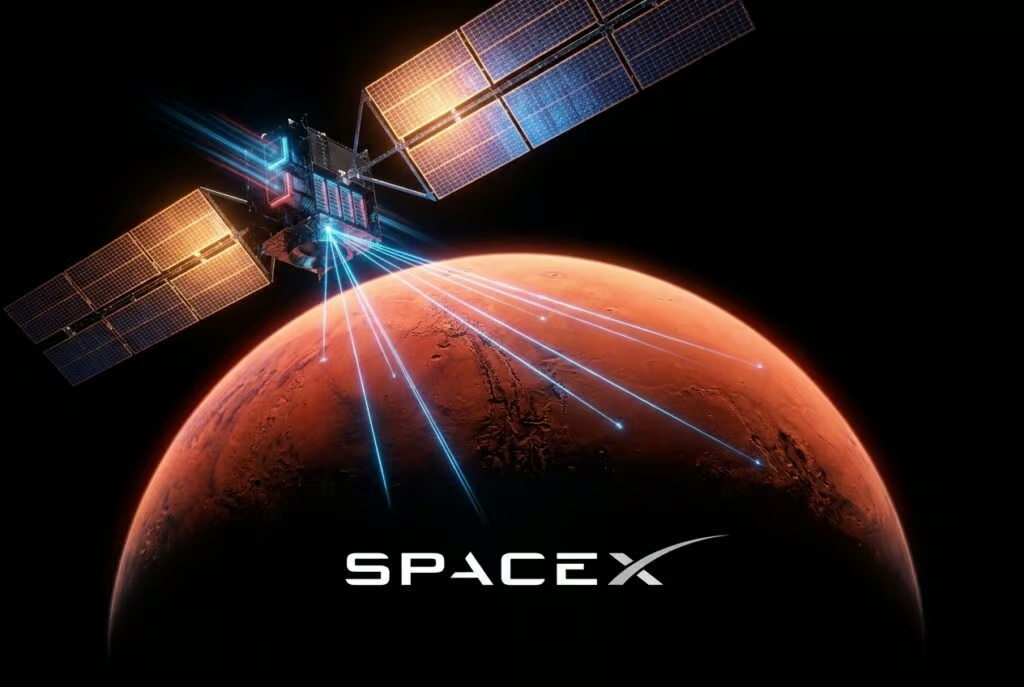
SpaceX, Google, and Anthropic confirmed in early 2026 that they are building AI1, a fully operational, solar-powered AI data center designed to live in low Earth orbit at roughly 550 kilometers. Slated to launch aboard a SpaceX Starship in Q3 2027, the project will be fueled exclusively by the sun and cooled by the vacuum of space, and will use Google TPU v6e accelerators paired with Anthropic inference engines.
Moving AI compute to orbit redefines where intelligence lives, alongside solving power and cooling challenges.
Why It Matters
Training the largest AI models now consumes electricity on par with small cities. The International Energy Agency estimates that data center electricity demand could double by 2030, driven largely by AI workloads. That trajectory is colliding with land constraints, transmission bottlenecks, and sustainability mandates. Placing a data center in orbit offers an escape from terrestrial grids, sidesteps water-intensive cooling, and taps into a constant, unobstructed source of solar energy.
Low Earth orbit (LEO) also puts compute closer to a globally distributed user base for certain inference tasks. Instead of routing a request from Mumbai to a server in Virginia, AI1 could process it overhead and beam the answer directly to a local ground station with far fewer network hops. The partners see the project as a way to test whether orbital edge computing can reduce latency for generative AI responses and lower the carbon cost of serving billions of daily queries. Google Cloud’s leadership has described it as the next logical step in their carbon-intelligent computing platform.
How Does AI1 Work? Power, Cooling, and Orbit
AI1 is designed as a modular cluster of compute nodes mounted on a SpaceX-built satellite bus. Each node contains Google’s TPU v6e accelerators and Anthropic’s fine-tuned inference engines. The entire structure is powered by a pair of unfolding solar arrays that stretch over 40 meters tip-to-tip, generating roughly 100 kilowatts of power, comparable to a modest terrestrial data center hall. Because there’s no atmosphere to attenuate sunlight, the panels operate at roughly 1.36 kW/m², about 40 percent higher peak irradiance than the best solar farms on the ground.
Cooling is the bigger engineering feat. In a vacuum, heat can’t escape through convection, only through radiation. AI1’s thermal management relies on a two-phase pumped loop that carries heat from the chips to large deployable radiators coated with a high-emissivity white paint. SpaceX’s satellite thermal engineers sized the radiators to handle a continuous 30-kilowatt thermal load, keeping junction temperatures below 85°C even during sustained full utilization. Early prototypes tested on SpaceX’s Transporter rideshare missions demonstrated that the radiators can maintain stable temperatures while the satellite cycles between solar exposure and Earth’s shadow every 90 minutes.
The orbital path is sun-synchronous, so AI1 will pass over the same ground points at roughly the same local solar time each day, simplifying optical downlink scheduling. Google and Anthropic have built a network of 12 ground stations using optical laser links, capable of receiving 100 Gbps of data per pass. During the roughly 10-minute window over each station, AI1 can offload results and receive new model shards. Between passes, the cluster handles inference requests that don’t require ground interaction, effectively becoming a self-contained AI service in orbit.
The Numbers
- 100 kW solar generation: enough to power approximately 600 TPU v6e chips continuously while in sunlight (Google Cloud, 2026).
- 3 ms signal latency from a 550 km orbit to the ground station, versus 40-100 ms for a typical terrestrial round-trip across continents.
- 30 kW thermal load dissipated by deployable radiators, keeping chip temperatures under 85°C in vacuum.
- 12 ground stations with laser uplink/downlink capacities of 100 Gbps each.
- Zero water consumption for cooling, a stark contrast to the millions of gallons per day used by large Earth-bound AI data centers.
“Orbital data centers could drastically reduce the carbon impact of AI inference and give us a genuinely global low-latency footprint. AI1 is our first step toward proving that at scale.”
, Thomas Kurian, CEO, Google Cloud
What Comes Next
The AI1 launch is scheduled for Q3 2027 aboard a SpaceX Starship, benefitting from the vehicle’s large payload fairing and ability to carry the cluster as a single integrated unit. The first six months of operation will be a pure R&D phase: testing thermal stability, radiation hardening, and performance consistency of liquid-cooled TPUs in microgravity. Google has already committed to at least three follow-on launches if AI1 meets its KPIs, with a longer-term vision of a constellation of 40-60 orbital nodes that can function as a distributed supercomputer.
Anthropic is contributing its Constitutional AI training framework to see whether model fine-tuning can happen entirely in orbit, using on-station energy. If successful, it would be the first example of a major AI model update performed without touching a terrestrial grid. SpaceX, for its part, is evaluating Starlink’s laser mesh to connect multiple AI1 nodes into a space-based data center mesh, potentially reducing the need for downlink hops.
Is Orbital Compute Realistic?
The economics remain the largest unknown. Launching a metric ton of hardware to LEO still costs between $1,500 and $2,000 per kilogram on Starship’s current pricing, even if costs drop further. A 100 kW payload with radiators, batteries for eclipse periods, and radiation shielding is heavy, likely 8 to 12 metric tons. That translates to a launch cost that rivals the bill for a small ground data center build. For AI1 to beat terrestrial equivalents on total cost of ownership, it must leverage the 24/7 solar resource and avoid the electricity pricing and cooling infrastructure that dominate ground-based TCO. Early internal estimates from Google suggest a 3- to 5-year payback for inference-only workloads, provided the satellite achieves a 99.9 percent uptime.
Radiation is the other durability question. Cosmic rays and solar particle events can flip bits in memory, requiring hardened chips or triple-redundant error correction. SpaceX’s experience with Starlink satellites, which have withstood thousands of orbits with minimal failures, gives the team confidence, but AI accelerators are more complex than routing hardware. The first year of AI1 operations will be as much a stress test for silicon as for software.
What Does This Mean for Your Business?
Even if you don’t operate a satellite, the engineering decisions behind AI1 will influence how AI services reach your customers. When major inference workloads move to orbit, location-based latency becomes a new variable in AI search and voice assistant performance. Businesses that rely on real-time AI responses, chatbots, local recommendations, appointment booking agents, may see faster and more consistent service because a node overhead is closer than a data center three continents away. That shift starts to blur the line between “edge” and “cloud,” which is why tools like AI contactability auditing and local SEO now need to account for networks where the server isn’t sitting on Earth.
We’ve already covered how orbital AI data centers could reshape AI search for small businesses, and many of the same principles apply here. The same way you optimize a business profile for AI findability in 2026, an orbital inference fleet will reward structured, location-tagged data that can be served efficiently during a 10-minute ground pass.
You probably won’t buy compute from an orbiting node directly anytime soon. But the services that depend on that compute, generative search summaries, AI-powered voice assistants, real-time translation, will arrive faster and with less environmental weight. Keeping your digital presence AI-ready, with accurate structured data and a consistent footprint across platforms, remains the practical way to ensure that whichever direction the data center market takes, up or out, your business appears in the answers that matter.
The Bigger Picture
SpaceX AI1 represents a genuine attempt to solve AI’s converging energy, land, and latency challenges with a clean-sheet approach. It may succeed, it may prove uneconomical after the first constellation, but the questions it raises about compute geography, network topology, and sustainability will define the next decade of AI infrastructure. Whether or not your own workloads ever leave the ground, the bar for what “fast” and “green” mean in AI has just been raised to orbital altitude.
FAQ
What is SpaceX AI1?
AI1 is a solar-powered orbital AI data center being developed by SpaceX, Google, and Anthropic. It runs Google TPU v6e accelerators and Anthropic inference engines on a SpaceX-built satellite bus, orbiting at roughly 550 km in low Earth orbit.
How does AI1 cool itself in space?
Without air for convection, AI1 uses a two-phase pumped liquid loop to move heat from the chips to large deployable radiators coated with high-emissivity white paint. The radiators shed heat as infrared radiation, handling a continuous 30 kW thermal load and keeping chip junctions below 85°C.
When will AI1 launch and what comes after?
AI1 is scheduled to launch in Q3 2027 aboard a SpaceX Starship, followed by a six-month R&D phase. Google has committed to at least three follow-on launches if AI1 meets its KPIs, with a longer-term vision of a constellation of 40-60 orbital nodes.
Related coverage
Run a free scan to see your AI Visibility Score, SEO rating, and local citation accuracy.