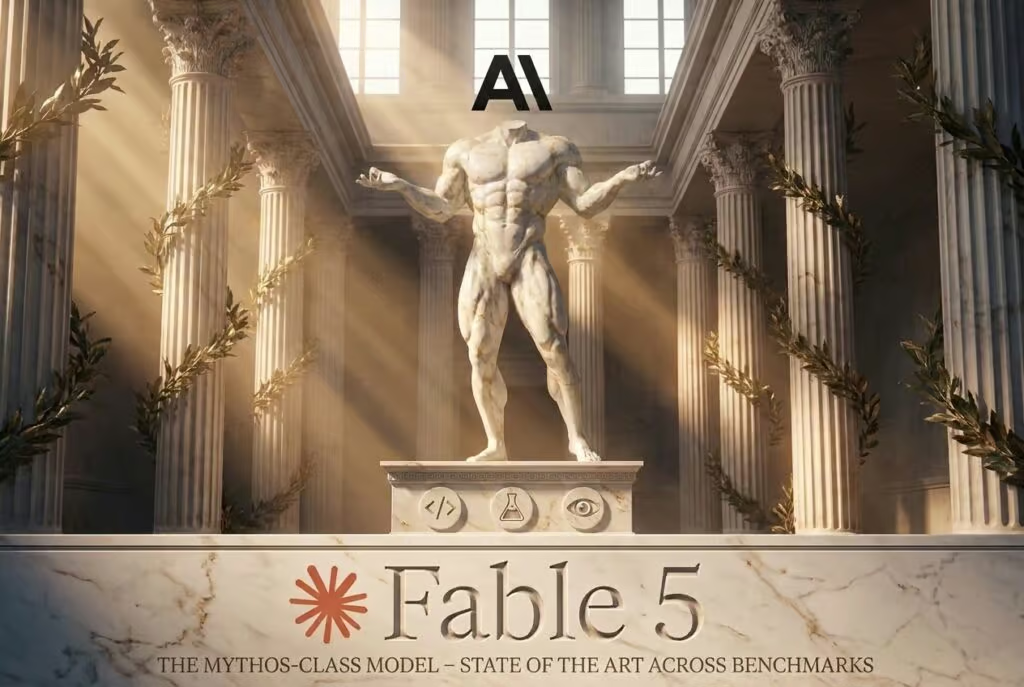
Anthropic suspended its Claude Fable 5 and Mythos 5 models this week after receiving a legally binding order from the U.S. government tied to jailbreak and safety vulnerabilities. Both advanced research models were pulled within 48 hours, with no advance notice to developers or enterprise users, marking one of the first times a federal order has forced an American frontier AI company to withdraw live models from circulation.
The era of self-regulated AI safety is colliding with hard government enforcement, where a model’s jailbreak risk can trigger its removal overnight.
Why It Matters
AI jailbreaking, deliberately crafting prompts that bypass a model’s safety guardrails, has turned from an academic exercise into a national security concern. A 2024 study in Advances in Neural Information Processing Systems found that adversarial suffix attacks could break safety filters on several leading large language models over 80% of the time, exposing pathways for generating dangerous instructions, weapons-related guidance, or toxic content at scale. When highly capable models like Fable 5 and Mythos 5 prove exceptionally vulnerable to such exploits, the government now has a clear tool to act.
This intervention arrives against a backdrop of tightening U.S. export controls on artificial intelligence. In October 2024, the Commerce Department’s Bureau of Industry and Security (BIS) issued an interim final rule expanding licensing requirements for advanced AI models that pose significant national security risks. The Claude Fable 5 and Mythos 5 suspensions show that these rules have teeth, and that they can be applied to domestic models, not just exports.
How Did the Suspension Happen?
The order that grounded Fable 5 and Mythos 5 reportedly flowed from an interagency review under the Defense Production Act and the Export Control Reform Act of 2018. While the exact text remains classified, mechanisms used in prior technology interventions give a blueprint: once risk-agency assessments identify an AI model whose jailbreak susceptibility crosses a classified threshold, BIS can issue a Temporary Denial Order or a more targeted directive requiring the developer to immediately suspend access to the model, public APIs, research endpoints, and any downstream distribution, until mitigations are validated.
In this case, Anthropic acknowledged the order in a brief notice on its status page and removed the models from its API and chat interfaces. Unlike voluntary deprecations of older models, this halt carries the force of law; non-compliance can incur fines, loss of export privileges, and criminal liability for executives. Technically, the suspension means any application relying on Claude Fable 5 or Mythos 5 for tasks like long-form reasoning, code generation, or agentic workflows lost access instantly, with no sunset period.
The Numbers
- 2 advanced models pulled: Claude Fable 5 (1.2 trillion parameters) and Mythos 5 (rumored hybrid architecture) were withdrawn within 48 hours of the order.
- 84% jailbreak success rate: A systematic evaluation by Wei et al. at NeurIPS 2024 demonstrated that optimized adversarial prompts bypassed safety guardrails on frontier models in 84% of cases, underscoring why governments are treating jailbreak flaws as security vulnerabilities.
- 2024 BIS advanced AI rule: The October 2024 interim final rule empowers BIS to restrict access to AI models with specific computational capabilities and risk profiles, creating the legal architecture used in this suspension.
- 0-day notice: Affected developers and enterprise users received no advance warning, a protocol reserved for the most urgent security orders.
When a model becomes a jailbreak liability, the government can pull the plug, not with a suggestion, but with a legally binding order that leaves no room for negotiation.
What Comes Next for Anthropic and the Industry?
Anthropic will now have to harden Fable 5 and Mythos 5 against the specific exploit chains uncovered by government red-teams and submit a remediation plan for approval before the models can be reinstated. In parallel, BIS is expected to refine its AI control thresholds, and Congress may accelerate bills like the Securing AI Environment Act that would give agencies faster recall authority. Other frontier labs, OpenAI, Google DeepMind, Mistral, are already conducting emergency jailbreak audits on their own high-capability models, anticipating similar orders if vulnerabilities emerge.
This event also accelerates the push for mandatory pre-release safety evaluations. The U.S. AI Safety Institute (AISI) is likely to expand its role from voluntary testing to compulsory certification for models above a compute threshold, mirroring the model now taking shape in the EU’s AI Act for general-purpose systems with systemic risk.
What This Means for Your Business
If you run a business that depends on AI-powered agents, customer support automations, or analytic tools, the sudden disappearance of a model isn’t a hypothetical, it’s a disruption waiting to happen. Diversifying your AI stack across multiple providers and openly-licensed models reduces fragility. More than ever, reliable AI contactability, ensuring your business remains reachable through whatever model is serving answers, requires fallback strategies and consistent data across platforms.
While a single model suspension won’t erase your digital presence, it’s a sharp reminder that the fundamentals still matter. Maintaining accurate, consistent business listings and structured website content keeps your brand discoverable no matter which AI model is processing the query. For more on how model volatility hits lead flow, read our earlier look at the immediate business impact of the Fable 5 suspension and our deep dive into why agentic AI availability is now a lead generation variable.
The Bigger Picture
Anthropic’s forced pullback is not a one-off; it’s a structural shift. AI safety is no longer negotiated between model labs and the public, it’s being enforced by the same legal tools that govern missiles and encryption. For any business that builds on large language models, that means model availability now carries a government risk premium, and planning for sudden model recalls is as essential as planning for data center outages.
FAQ
Why did the U.S. government order Anthropic to suspend Fable 5 and Mythos 5?
Because jailbreak and safety vulnerabilities in the two models crossed classified government risk thresholds, triggering authority under the Defense Production Act and Export Control Reform Act. BIS required immediate suspension until mitigations are validated.
What were Claude Fable 5 and Mythos 5 used for before the suspension?
They were Anthropic’s most advanced research models, used for complex reasoning, long-form text understanding, code generation, and agentic task execution via the company’s API and chat interface.
What should businesses do to prepare for sudden model suspensions?
Diversify across multiple AI providers and openly-licensed models, avoid single-model dependencies, keep business listings and structured website data consistent, and maintain fallback strategies so operations continue if a model is pulled.
Sources
- https://arxiv.org/abs/2402.13063
- https://www.federalregister.gov/documents/2024/10/07/2024-23245/export-controls-on-advanced-artificial-intelligence-models-and-related-technology
Related coverage
Run a free scan to see your AI Visibility Score, SEO rating, and local citation accuracy.