
Stronger visibility in search and AI results comes from doing the foundational SEO work well, then layering proof on top of it. The ten practices below cover the basics that get content into the running, the signals that give engines a reason to choose it, and the changes needed as AI agents and answer engines handle more of the discovery process.
What counts as an SEO best practice in 2026?
An SEO best practice is a repeatable method that helps search engines and AI systems access, understand, trust, and surface content. SEO now influences more discovery surfaces than it used to. People can encounter brands through AI Overviews, AI Mode, ChatGPT, Gemini, Perplexity, voice assistants, recommendation systems, and AI agents. The core fundamentals have not disappeared: search intent, useful content, technical accessibility, expertise, authority, and trust all still matter. The difference is that these fundamentals are evaluated and reused by more systems at once. Following them is the entry requirement, not a guarantee of visibility. Rankings, mentions, and citations usually depend on what is built on top of the basics, including original evidence, demonstrated expertise, fuller coverage of the task, and recognition from sources beyond the site itself.
How the ten best practices fit together
The practices group into three layers:
- Build the foundation: match search intent, develop topical authority, structure content clearly, remove technical barriers, and optimize images.
- Give systems a reason to choose you: demonstrate real expertise, publish original evidence, and build recognition beyond the website.
- Adapt and measure: make the site easier for AI agents to use, then track visibility across Google and AI platforms.
1. Understand what your audience wants
To earn visibility, content needs to match what people are actually trying to accomplish. That goal behind a query or prompt is the search intent. For example, someone searching for “best SEO tools” likely wants to compare products before choosing one. To check intent, look at what Google returns and what an AI tool like ChatGPT returns for the same query, then assess whether the searcher wants to learn, compare, or buy.
Start with keyword research to find what the audience searches for and how often. Enter a broad topic into a keyword tool, then look for terms with real search volume and a difficulty score the site can compete at. A prompt research tool can reveal the search intent behind topics and prompts used across AI platforms. Intent is more than a label like commercial or informational. The complete task behind the search usually includes the questions users want answered, the information and format they expect, the criteria they use to decide, and likely follow-up questions. People Also Ask results, communities, reviews, support tickets, and customer conversations surface needs and language that keyword data misses.
Write for how people ask AI
Queries typed into Google tend to be short, such as best CRM small business. The same person might ask ChatGPT a longer version, like what is a good CRM for a growing business that is easy to use and does not cost a fortune. The longer version tells what they care about, so price, ease of use, and room to grow should be built into the page. Reviewing Reddit threads, sales calls, and AI prompt data shows how the audience describes the problem in their own words. Each page should serve one clear primary intent. Closely related terms such as “SEO best practices,” “best SEO practices,” and “best practices for SEO” can usually be covered together when they serve the same underlying need. The goal is satisfying the task, not matching keywords one by one.
2. Focus on topical authority
Topical authority comes from covering an important subject deeply across a group of useful, connected pages. It helps search engines and AI systems recognize the site as a credible source on topics relevant to the business. Google’s December 2025 core update is widely seen as rewarding topical authority, favoring specialization, expertise, and commercially oriented content from specialized brands over generic ecommerce platforms.
A common way to build topical authority is with topic clusters. Pick a core topic related to the business, then create a pillar page that gives a broad overview and links out to cluster pages covering related subtopics. Nesting URLs further clarifies the structure, with subpages sitting under the pillar page in the path. Internal links should connect the pillar and cluster pages so readers, search engines, and AI tools can navigate the content and understand how pieces relate. Updating the pillar and cluster pages regularly with new insights, data, and examples shows that the content stays current.
Refresh and improve existing content
Building topical authority does not always mean publishing more content. Often more value comes from improving pages that already have some visibility or authority, including pages earning search impressions or rankings, organic traffic, backlinks or brand mentions, and AI mentions or citations. These pages have already shown some value to search engines, AI systems, or other sites, which makes them strong candidates for improvement. Ways to make a page meaningfully better include updating outdated advice or examples, expanding weak or incomplete sections, adding missing examples, evidence, or firsthand experience, supporting claims with stronger sources, filling gaps in intent coverage, and strengthening internal links. Changing the publication date or making minor wording edits is not a real content refresh.
3. Structure content so search and AI systems can extract it
Clear structure makes content easier for readers to scan and helps search engines and AI systems identify useful passages to surface. Start with basic on-page signals. Include the primary keyword naturally in the title tag, H1, and meta description, and make sure each one accurately reflects the page’s topic and search intent. The title tag and H1 do not need to match word for word, and the meta description is not a direct ranking factor, but all three should make the topic immediately clear.
Within the content itself, use descriptive headings that explain what each section covers, then answer the heading directly in the first sentence or paragraph. Content is easier to understand and extract when paragraphs stay short and focused on one idea, lists are used for steps or grouped information, tables are used when readers need to compare options, unfamiliar terms are defined clearly, long sections are broken into subheadings, and important claims stand on their own without depending heavily on surrounding paragraphs.
The last point matters for AI search specifically. Research on content optimization found that pages cited by AI scored about 33 percent higher on clarity and summarization than pages that only ranked in Google, 25 percent higher on Q and A formatting, and 23 percent higher on section structure. AI systems often retrieve or quote individual passages rather than reproduce a whole page, so an important statement should make sense when taken out of its original context. The goal is making content quotable rather than simply adding more formatting.
4. Do technical SEO, including AI crawler access
Technical SEO matters because content cannot earn visibility if search systems cannot reliably access and process it. A sound technical base also helps AI agents navigate the site, interpret key elements, and complete actions reliably on a user’s behalf. Before diagnosing rankings or traffic, confirm that important pages are actually indexed. Then check for crawl blocks or accidental noindex directives, incorrect canonicals, broken links and redirect chains, XML sitemap problems, poor mobile usability or page performance, and important content that depends on JavaScript to render.
Managing search and AI bot access through robots.txt controls which crawlers can reach the site. Site audit tools can surface these issues at scale, and a dedicated module that flags pages blocked from AI search helps spot content that is invisible to AI crawlers while still reachable by traditional ones. Speed, mobile usability, security, and crawlability are the baseline checks.
5. Optimize images for search
Optimized images improve user experience and are more likely to gain search visibility. Use descriptive file names and add alt text that explains what the image shows. Compress files to keep pages light, and enable lazy loading so images below the fold do not slow the initial render.
6. Showcase E-E-A-T
Content written by credible experts with real experience is more likely to perform well and be cited. Showcasing experience, expertise, authoritativeness, and trustworthiness includes adding author bios, citing reputable sources, and including real examples or data.
7. Publish original data and citable evidence
Specific evidence gives publishers and AI systems a reason to cite the content over a generic competitor. Turning firsthand experience into evidence-backed content, then publishing it where peers and journalists can find it, creates a reason for others to link back. Established research hubs and thought-leadership frameworks are useful references for what this looks like in practice.
8. Build an off-site presence where search and AI systems look
Brand mentions and backlinks from trusted sources build the credibility AI systems look for. Backlinks and brand monitoring tools track who is talking about the brand and where new links appear. The strongest off-site presence usually comes from creating content worth linking to and using direct outreach to earn placements, with a priority on relevant placements over high-volume generic links.
9. Prepare for agentic search and commerce
AI agents need accurate, structured data and a well-maintained accessibility tree to act on the site on a user’s behalf. That means keeping pricing, specs, inventory, and identifiers accurate, using Product and Offer schema markup and structured feeds, and running accessibility scans to confirm the site is usable by assistive technology and by automated agents alike.
10. Monitor performance across Google and AI search
Measuring results shows whether SEO efforts are working, and going beyond rankings and traffic captures the full value of SEO. Position tracking and AI visibility toolkits can monitor organic rankings, AI mentions, citations, and Share of Voice over time, so gains and losses show up before they become a problem.
For businesses that want a structured read on their own visibility, an AI visibility score that pulls in listing data across directories is a practical starting point. BizScoreAI tracks how a business appears to AI search and shows what its listing looks like to the engines people ask.
FAQ
What is an SEO best practice?
An SEO best practice is a repeatable method that helps search engines and AI systems access, understand, trust, and surface content. It covers technical foundations, on-page structure, content quality, off-site signals, and measurement.
Why does topical authority matter for SEO?
Topical authority signals that a site covers a subject deeply across connected pages, which helps search engines and AI systems treat it as a credible source. Google’s December 2025 core update is widely seen as rewarding specialization and expertise, making topical authority a stronger competitive factor.
How is AI search changing SEO best practices?
AI systems retrieve and quote individual passages, so content needs to be structured so important claims stand on their own. Pages cited by AI have scored higher on clarity, Q and A formatting, and section structure than pages that only rank in Google. AI agents also need accurate structured data, schema markup, and a clean accessibility tree to act on a site on a user’s behalf.
Related coverage
- Fresh Content and AI Visibility: What SEO Teams Need to Know – BizScoreAI
- Creator Content in AI Search Visibility Strategy
- 5 Ways to Boost Your AI Search Visibility (And Actually Get Cited) – BizScoreAI
SEOScanPro
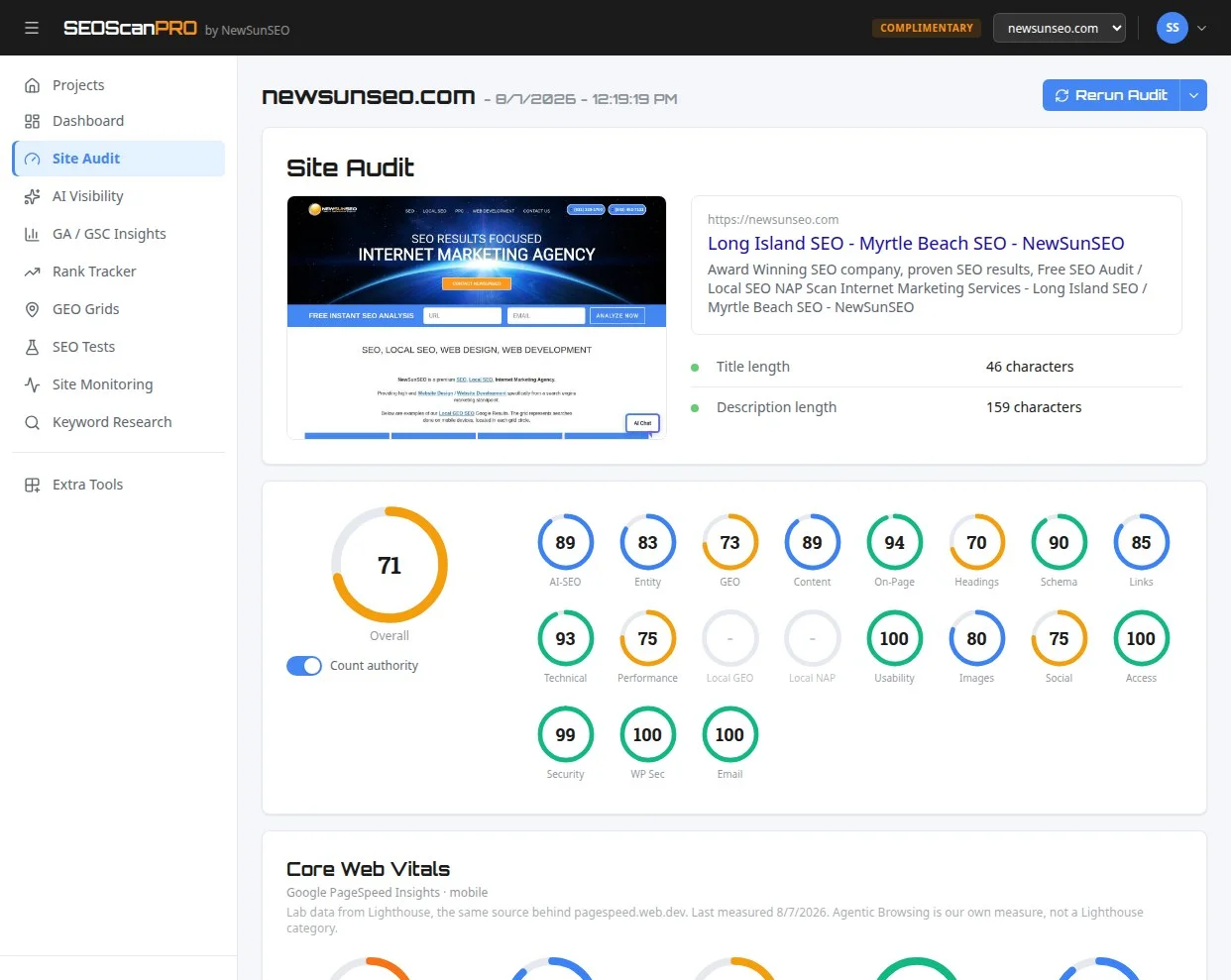
SEOScanPro has the site audit tool runs a full technical audit of a site and shows the measured result behind every check. Open the site audit tool.
This article summarizes reporting from semrush.com. See our editorial disclaimer for how our articles are produced.
Run a free scan to see your AI Visibility Score, SEO rating, and local citation accuracy.