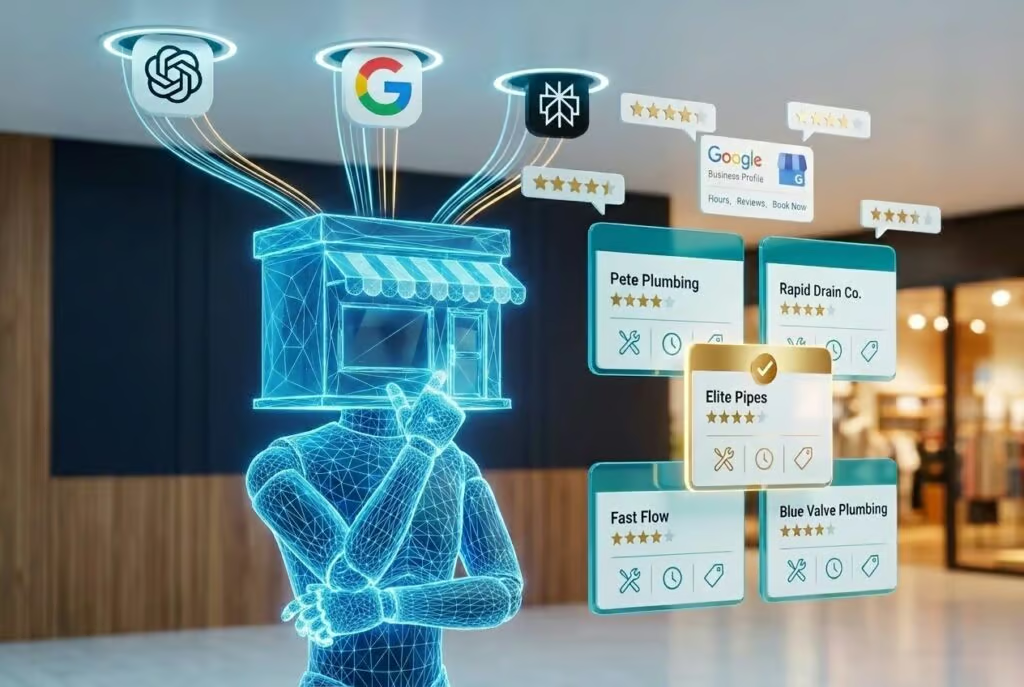
Search is no longer a list of blue links. A prospective customer can now ask ChatGPT, “Find me a highly rated plumber available tomorrow in Portland who accepts credit cards”, and get a single recommended business. With 68.2% of Google searches ending without a click to the open web, businesses that aren’t structured as clear, trusted answers are invisible to the fastest-growing lead channel of 2026.
AI doesn’t crawl links, it reads meaning. To be found, your business must become the most structured, trusted answer to the question your customer is asking.
Why It Matters
AI-assisted search is no longer a niche experiment. OpenAI’s ChatGPT, Google AI Overviews, Perplexity, and Gemini now answer millions of queries every day by synthesizing information from across the web rather than returning a list of pages. When a user asks for a service provider, the AI picks a few candidates based on how clearly and credibly the business describes itself across multiple sources. If your NAP (name, address, phone), services, pricing, and reviews are scattered, vague, or incomplete, the AI simply won’t see you.
The scale of the shift is staggering. 68.2% of Google searches now end without a click to the open web, according to Rand Fishkin’s latest zero-click study. Meanwhile, 23% of U.S. adults have used ChatGPT as of early 2024, a figure that continues to climb. This isn’t a future problem, it’s the reality your next customer lives in today.
How AI Search Finds Your Business Now
AI engines don’t rank websites the way traditional search does. They pull from a blend of training data, live web content, knowledge graphs, and structured feeds (like Google Business Profile and directory listings). They prioritize trust signals: consistent citations, recency, specificity, and explicit statements of what a business does, where it operates, how much it costs, and why it’s the best choice.
Here are the 10 things that move the needle most when it comes to AI discoverability:
- Claim and fully complete your Google Business Profile. Fill in every attribute: hours, services, products, payment methods, accessibility, and service areas. Use the description to state exactly what you do and for whom. AI models ingest Business Profile data directly from Google’s Knowledge Graph.
- Structure your website with semantic triples. A semantic triple is a simple subject-predicate-object statement: “We service Portland,” “Our average repair cost is $150,” “We offer same-day appointments.” Place these statements as prominent text on your homepage and service pages so AI can parse them as facts, not marketing fluff.
- Diversify reviews across Google, Yelp, BBB, and industry-specific sites. An AI agent counts variety in review sources as a trust signal. If all your reviews live on one platform, you appear less established.
- Encourage detailed reviews that mention the specific service and problem solved. “Great service” is useless. “They fixed my burst pipe at 9pm on a Sunday for under $300” gives AI the keywords, service context, and price point it needs to match real-world queries.
- Get mentioned in the sources AI tools already cite. Search your main keywords in ChatGPT, Perplexity, or Google AI Overviews and note which directories, blogs, news sites, and forums appear. Pitch those outlets for a mention or create profiles there.
- Build a presence across blogs, podcasts, YouTube, Reddit, and local news. The more distinct, authoritative domains that mention your business with consistent information, the more your entity strengthens in the AI’s knowledge graph.
- Publish Google Posts with clear, structured offers. Lead with your value proposition in the first 80 characters, keep videos under 30 seconds, and use scheduling and repeat features for recurring offers. Google Posts feed directly into your Knowledge Panel and can surface in AI Overviews.
- Answer five questions instantly on your homepage. What do you do? Where do you serve? What does it cost? Why choose you? How do I book? These answers should be visible without scrolling, in plain HTML text, not buried in a PDF or image.
- Keep NAP consistent everywhere. A single mismatched suite number between your GBP and a directory listing can fragment your entity and reduce AI confidence.
- Monitor and test your visibility in AI tools. Regularly search for your core service + location in ChatGPT, Perplexity, and Google AI Overviews. Note which competitors appear and reverse-engineer what they’re doing better.
The Numbers
- 68.2% of Google searches in the U.S. and EU end without a click to the open web (SparkToro, 2024).
- 76% of people who search on a smartphone for something nearby visit a related business within 24 hours (Google).
- 23% of U.S. adults had used ChatGPT as of February 2024, doubling from the previous year (Pew Research Center).
“In 2024, an estimated 68.2% of Google searches in the US and the EU end with no click.”
, Rand Fishkin, founder of SparkToro
What Comes Next
Agentic AI is the next wave. Assistants will not only recommend your business but book appointments, process payments, and complete transactions without a human ever visiting your website. Google I/O 2026 previewed AI agents that can fill forms and call businesses on behalf of users. To prepare, you need structured booking links, clear pricing schema, and real-time availability data that AI can act on.
Voice search, already a growing share of mobile queries, will compound the trend. Spoken queries are even more conversational and intent-rich: “What’s the cheapest plumber near me who can come now?” Your business listing must answer that question in a single, structured fact the AI can read aloud.
What This Means for You
Your playbook is clear. Start by claiming and verifying your listing using our get listed tool. From there, shift your mindset from “ranking” to “being structured.” The single best thing you can do today is write real facts, service details, location claims, price ranges, as plain text on your website.
Next, audit your AI contactability. Can a conversational agent extract your phone number, hours, and payment methods from your site and listings without friction? If not, you’re losing leads to a competitor who made it easy.
Then expand your footprint. A robust presence across business listings sites, social platforms, and industry directories feeds the AI’s confidence model. As we covered in our breakdown of zero-click search, 68% of Google searches now end without a click, making AI-friendly listings more critical than ever. And with agentic AI on the rise, these assistants can now book appointments and make purchases, so having a connected, structured profile is the new storefront.
Finally, keep your social presence consistent using an AI social media manager like Feedsta.ai, which creates, schedules, and analyzes posts across platforms so your brand stays visible wherever and however customers search.
The Bigger Picture
AI search rewards businesses that act like databases, not billboards. The more explicitly you state what you do, where you do it, what it costs, and why a customer should choose you, the more you become the obvious answer in a conversational query. In an era where 68% of searches go clickless and AI agents make decisions on behalf of users, the businesses that speak clearly to machines are the ones that will keep hearing the phone ring.
FAQ
How does AI search differ from traditional Google search?
Traditional search returns a list of links based on page authority and keyword relevance. AI search, such as ChatGPT or Google AI Overviews, reads and synthesizes information from multiple sources to generate a direct answer or a single recommendation. It favors structured, explicit statements of fact (who, what, where, cost) and trust signals like review breadth and directory consistency over backlinks alone.
Why do reviews matter for AI discoverability?
Reviews matter because AI models treat them as real-world validation. Detailed, recent reviews across platforms (Google, Yelp, BBB, industry sites) signal credibility and provide the AI with the exact language customers use, keywords like “emergency,” “affordable,” and specific service names, which improves the match rate for conversational queries.
What is a semantic triple and how do I add it to my website?
A semantic triple is a simple, machine-readable statement structured as subject, predicate, object, such as “We serve Portland” or “Our average repair cost is $150.” You add them by writing plain, declarative sentences as HTML text on your homepage and service pages. Avoid burying this information inside images, sliders, or PDFs, AI must be able to read it directly as text.
Sources
- undefined
- undefined
- undefined
Run a free scan to see your AI Visibility Score, SEO rating, and local citation accuracy.