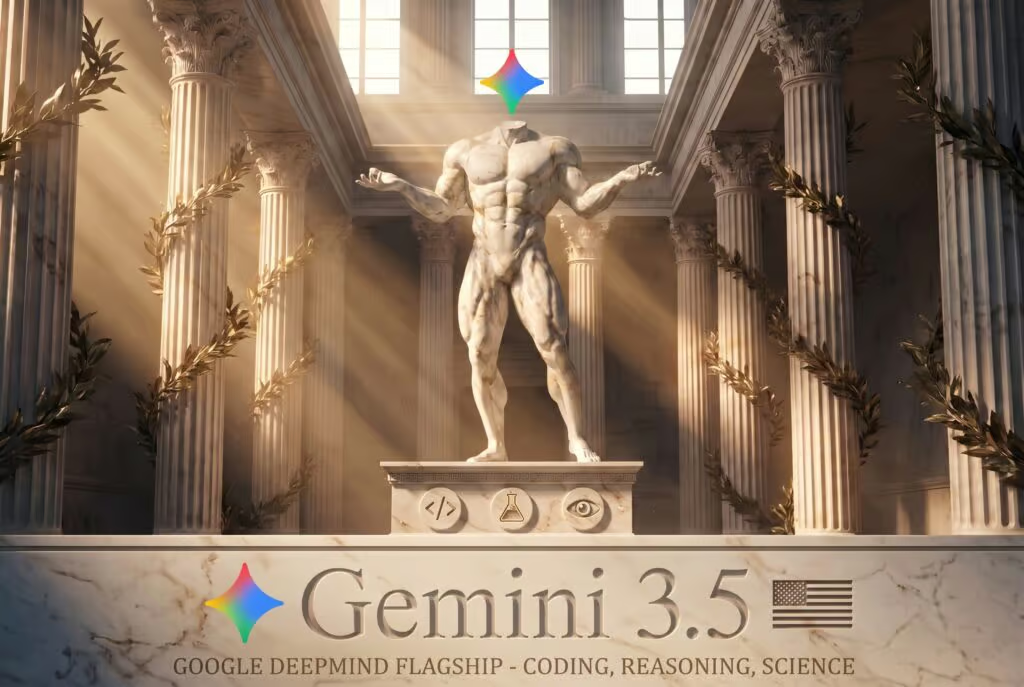
Google’s Gemini 3.5 Pro has slipped past its June 2026 launch window after coding performance failed to meet internal benchmarks, according to current and former employees. The miss, first reported by Bloomberg, sent Alphabet shares down roughly 4% in intraday trading as investors reacted to the holdup on a model CEO Sundar Pichai had previewed at the May I/O developer conference.
The delay of Gemini 3.5 Pro underscores a hard truth in the AI race: shipping a model that codes competently is proving far tougher than announcing it.
Why It Matters
The Gemini family is central to Google’s AI strategy. Gemini 3 helped the Gemini app cross 750 million monthly active users and pushed Alphabet’s market valuation beyond $4 trillion earlier this year. At I/O 2026 in May, Google positioned Gemini 3.5 Pro as the crown jewel of its AI roadmap, promising a faster, cheaper successor to the February-launched Gemini 3.1 Pro. Missing the June deadline hits the core of Google’s enterprise and developer credibility, especially as rivals sprint ahead with models built for writing and debugging code.
What’s New: The Coding Snag and Internal Fallout
According to the Bloomberg report, Google attempted a late-June training data refresh aimed at lifting Gemini 3.5 Pro’s coding skills, but the result was described as disappointing. Internal dissatisfaction ran high enough that some employees discussed scrapping previous base model versions entirely and starting over. Sources flagged structural issues with token efficiency, agentic capabilities, and the model’s ability to sustain performance over long-horizon tasks.
In a statement, a Google spokesperson said:
“We’re currently testing 3.5 Pro, an upgraded Flash model, and other models with partners, and we’re productively engaged with the U.S. government.”
, Google spokesperson
The spokesperson added, “We’re shipping quickly across a wide range of models while keeping them highly cost-effective for customers.” Inside Google, the picture is mixed. By April, 75% of all new code at Google was AI-generated and approved by engineers, up from 50% the previous fall, showing how heavily Google’s own developers rely on AI coding aids. The company is also working to unify fragmented internal AI coding tools, a sign that AI-assisted development is still being ironed out within the company itself.
The Numbers
- Google said Gemini 3.5 Pro would arrive in June 2026. As of mid-July, it has not shipped.
- Google refreshed training data in late June to improve coding results, but the outcome was deemed disappointing.
- Alphabet’s stock dropped approximately 4% in intraday trading on the day Bloomberg reported the delay.
- 75% of all new code at Google is AI-generated and approved by engineers, up from 50% the previous fall.
- The Gemini app now counts over 750 million monthly active users, and Alphabet’s market cap topped $4 trillion earlier this year.
What Comes Next
Google is now testing an upgraded Flash model alongside the delayed Pro, and some insiders suggested a possible mid-July launch, contingent on the current retraining efforts succeeding. Engagement with the U.S. government adds a newer variable: OpenAI’s GPT-5.6 launch was briefly delayed at the government’s request over misuse concerns, and Anthropic disabled Mythos 5 and Fable 5 after a June export control order before restoring them with added safeguards. Google said it remains “productively engaged” with the government, indicating that frontier model releases now require both technical and regulatory clearance.
Competitive pressure is not waiting. Chinese AI lab Zhipu released GLM-5.2, which matches Anthropic’s Opus 4.8 on coding benchmarks at a reported one-fifth of the cost. Moonshot AI dropped Kimi K3, a 2.8 trillion-parameter open-weight model. The window for Google to assert coding leadership is narrowing.
What This Means for You
For business owners, developers, and anyone tracking the practical progress of AI tools, the Gemini 3.5 Pro delay is a reminder that the state of the art is still uneven. Even a company with Alphabet’s resources can trip over coding, the very capability that is supposed to drive the next wave of enterprise automation. If your workflow depends on AI-generated code, expect models to keep improving but also to stumble in unpredictable ways. This is a good moment to diversify the tools you rely on.
While Google works through its issues, rival models like Kimi K3 and GLM-5.2 are pushing the envelope; our earlier coverage of Kimi K3’s open-source debut shows how quickly alternatives can emerge. Keeping a close eye on Google’s AI roadmap remains essential, as the company has repeatedly demonstrated it can pivot fast once technical hurdles clear. For a broader perspective on how AI shifts platform dynamics, see our analysis of durable SEO strategies in the AI era, and as our look at Google’s own search guidance highlighted, the company’s moves ripple across every corner of digital business. For now, the overarching lesson is that coding ability remains the hardest test of any large language model, and a delayed model may ultimately be safer than a rushed one.
The Bigger Picture
Google’s stumble with Gemini 3.5 Pro is not a sign that the company is falling out of the AI race, but it exposes how brittle progress can be at the frontier. The coding capabilities that separate great models from merely good ones are proving stubbornly difficult to engineer, and the bar keeps rising as open-source and Chinese competitors close the gap on conventional benchmarks. For the broader industry, the delay reinforces that shipping reliable, agentic AI systems is a marathon, not a sprint, and that even the most cash-rich lab can find itself a step behind when the metric that matters most is a model that actually writes solid code.
FAQ
Why did Google delay Gemini 3.5 Pro?
The model’s coding abilities fell short of internal benchmarks. Google updated training data in late June to improve coding, but the results were disappointing, with employees also flagging issues in token efficiency, agentic capabilities, and long-horizon task performance.
When will Gemini 3.5 Pro actually launch?
Google has not set a firm new date. Some insiders pointed to a possible mid-July window, but only if the current retraining efforts succeed. The company is also testing an upgraded Flash model alongside Pro.
How did the delay affect Alphabet’s stock?
Alphabet shares dropped approximately 4% in intraday trading on the day Bloomberg reported the internal delay, reflecting investor concern over the company’s AI competitiveness.
Related coverage
Run a free scan to see your AI Visibility Score, SEO rating, and local citation accuracy.