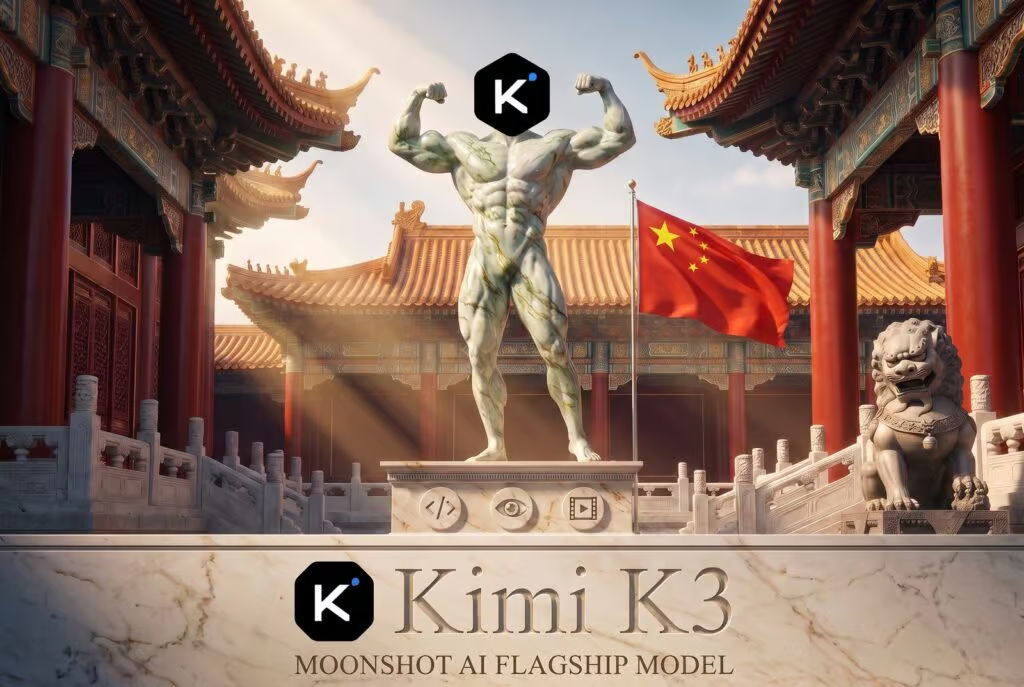
White House science and technology chief Michael Kratsios has accused China’s Moonshot AI of using industrial-scale distillation against Anthropic’s Fable 5 to train its Kimi K3 model, saying the company built an internal platform that constantly switched how it reached U.S. models to avoid detection. Moonshot also acquired Nvidia GB300 servers, Kratsios said, including units accessed in Thailand, which he linked to the effort to train the next-generation Chinese model.
What Kratsios said
In remarks reported this week, Kratsios framed the alleged activity as covert industrial distillation aimed at stealing proprietary U.S. technology and undermining American research. He said Moonshot ran large-scale distillation against U.S. models and disguised the effort by rotating between multiple methods of access.
Kratsios also said Moonshot obtained advanced Nvidia hardware, including GB300-equipped servers, and accessed GB300 systems in Thailand. The combination of model distillation and restricted-chip access, he argued, points to a coordinated effort to lift performance from U.S. frontier systems.
He contrasted that behavior with legitimate distillation, which the U.S. government views as a normal part of the open innovation ecosystem that produces smaller, more efficient models. Large-scale covert distillation aimed at cloning proprietary capability, he said, is not.
Anthropic’s earlier allegations
The accusation arrives against the backdrop of a complaint Anthropic filed in February, in which the company accused Moonshot AI, DeepSeek, and MiniMax of running industrial-scale campaigns to illicitly extract capabilities from its Claude family of models. Sarah Heck, a member of Anthropic’s policy team, has publicly described distillation in this context as IP theft and industrial espionage and tied the practice to national security risks.
Kratsios referenced the same pattern in his remarks, echoing Anthropic’s framing of distillation as a national-security concern rather than a routine research technique.
Why the timing matters
Moonshot released Kimi K3 last week, reporting benchmark scores at or near the U.S. frontier, and said the full model’s weights will be published on July 27. A publicly distributed open-weight release of a model with near-frontier scores would normally be treated as a meaningful contribution to the open ecosystem. The White House allegation reframes that release: if distillation is what produced K3’s capabilities, the open-weight release is, in Kratsios’s telling, a wider distribution of siphoned U.S. IP rather than independent Chinese research.
The allegation also lands in a political environment where U.S. officials have warned that export controls on advanced chips could be tightened or enforced more aggressively against Chinese AI labs. Access to GB300-class hardware through third countries, including Thailand, is exactly the kind of routing pattern those controls are designed to disrupt.
What the accusation does and does not establish
Public remarks from a White House official are not the same as adjudicated evidence. Kratsios did not, in the reported comments, disclose logs, model outputs, or technical artifacts that would let outside researchers verify the distillation claim. Anthropic’s February complaint made the same allegation category at a higher level, and the U.S. government has not, as of the reported remarks, released independent technical proof.
Two specific claims still need substantiation: that Moonshot’s training data or process drew materially on Fable 5 outputs rather than independent research, and that the GB300 systems Moonshot accessed were used specifically for K3 training rather than other workloads. Neither Anthropic nor the White House has put forward that evidence publicly.
If substantiated, the claim would shift how readers and policymakers interpret the July 27 weight release and would give the U.S. a concrete case to argue that open-weight releases can be vectors for stolen capability rather than independent science. If not substantiated, it remains a serious accusation that risks becoming a precedent for U.S. pressure on Chinese open-weight projects without a verified factual base.
FAQ
What did the White House accuse Moonshot AI of doing?
Michael Kratsios, the White House science and technology chief, accused Moonshot AI of running large-scale distillation against Anthropic’s Fable 5 to train its Kimi K3 model, and of building an internal platform that constantly switched how it reached U.S. models to avoid detection. He also said Moonshot acquired Nvidia GB300 servers, including systems accessed in Thailand.
Why is this allegation tied to national security?
Sarah Heck of Anthropic’s policy team has described distillation in this context as IP theft and industrial espionage and linked it to national security risks. Kratsios echoed that framing, calling covert industrial distillation aimed at stealing proprietary U.S. technology unacceptable, especially when paired with access to advanced Nvidia chips through third countries.
What is the Kimi K3 weight release scheduled for?
Moonshot released Kimi K3 last week with benchmark scores at or near the U.S. frontier, and said the full model’s weights will be published on July 27. The White House allegation lands just as that open-weight release is being prepared.
Related coverage
See our editorial disclaimer for how our articles are produced.
Run a free scan to see your AI Visibility Score, SEO rating, and local citation accuracy.