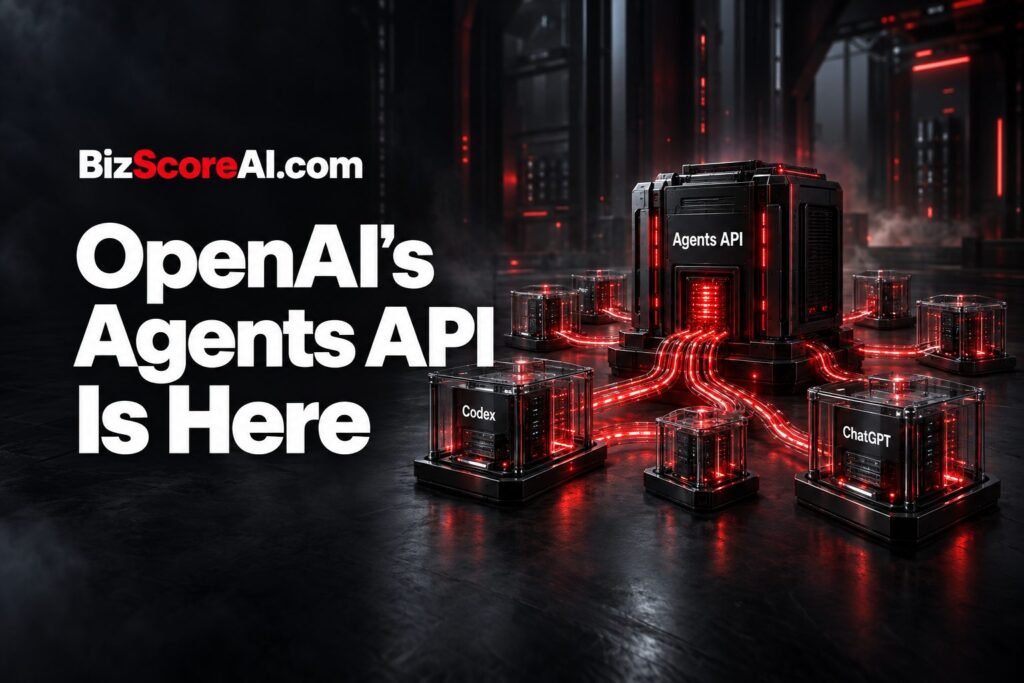
OpenAI has opened its Agents API as a public beta, giving any developer access to the same cloud infrastructure that runs Codex and ChatGPT. The release means developers can now build agents that run for hours, execute code, and process files without managing the underlying systems themselves.
What the Agents API offers
The Agents API exposes three capabilities that matter for long-running agent workloads:
- Automatic context management, so conversations stay coherent across multi-hour sessions.
- Parallel tool use, allowing an agent to call several tools at once instead of waiting on one at a time.
- Task delegation to sub-agents, which lets a primary agent hand off focused jobs and reassemble results.
Developers can pick where the agent runs. OpenAI offers hosted sandboxes, and partners including Cloudflare, Vercel, and Oracle provide their own execution environments. There are no extra platform fees beyond standard token usage billing.
Built on the open-source Codex harness
The API sits on top of the open-source Codex harness, the same system that powers the Codex coding agent. It supports MCP, custom functions, and built-in tools such as web search, so developers can plug in existing tools or build their own integrations.
By packaging the harness as an API, OpenAI turns an internal coding tool into a general-purpose agent platform that any application can call.
What developers can build now
With multi-hour runtime, code execution, file handling, and parallel tool calls available out of the box, the Agents API targets the kinds of jobs that previously required custom orchestration: research workflows that browse the web and compile findings, coding assistants that edit repositories over long sessions, and data pipelines that combine tools to transform files.
The ability to choose between OpenAI-hosted sandboxes and infrastructure from Cloudflare, Vercel, or Oracle gives teams flexibility on where their data is processed and how agents integrate with existing systems.
Why the Codex and ChatGPT pedigree matters
Codex is OpenAI’s coding agent, and ChatGPT is its flagship consumer product. Both depend on the same backbone that the Agents API now exposes. Developers who build on the API are using the same orchestration layer, context handling, and tool execution that already power production-scale products at OpenAI, rather than a stripped-down version built for external use.
The public beta status signals that OpenAI expects rough edges, but the feature set is the real product direction: agents that can be left running, that manage their own context, and that distribute work across sub-agents and tools in parallel.
Getting started
Documentation is available through OpenAI’s developer site, and the Codex harness source code is published on GitHub. Developers can begin building against the API during the beta, with billing tied to token consumption and no additional platform charges for the sandbox environments.
FAQ
What is the OpenAI Agents API?
The OpenAI Agents API is a public beta interface that lets developers build cloud-based agents capable of running for hours, executing code, and processing files. It runs on the same infrastructure that powers Codex and ChatGPT.
What features does the Agents API include?
The API includes automatic context management, parallel tool use, and the ability to delegate tasks to sub-agents. It supports MCP, custom functions, and built-in tools such as web search.
Where can agents built with the API run?
Agents can run in OpenAI-hosted sandboxes or on infrastructure from partners including Cloudflare, Vercel, and Oracle. There are no extra platform fees, with billing based only on token usage.
Related coverage
This article summarizes reporting from the-decoder.com. See our editorial disclaimer for how our articles are produced.
Run a free scan to see your AI Visibility Score, SEO rating, and local citation accuracy.