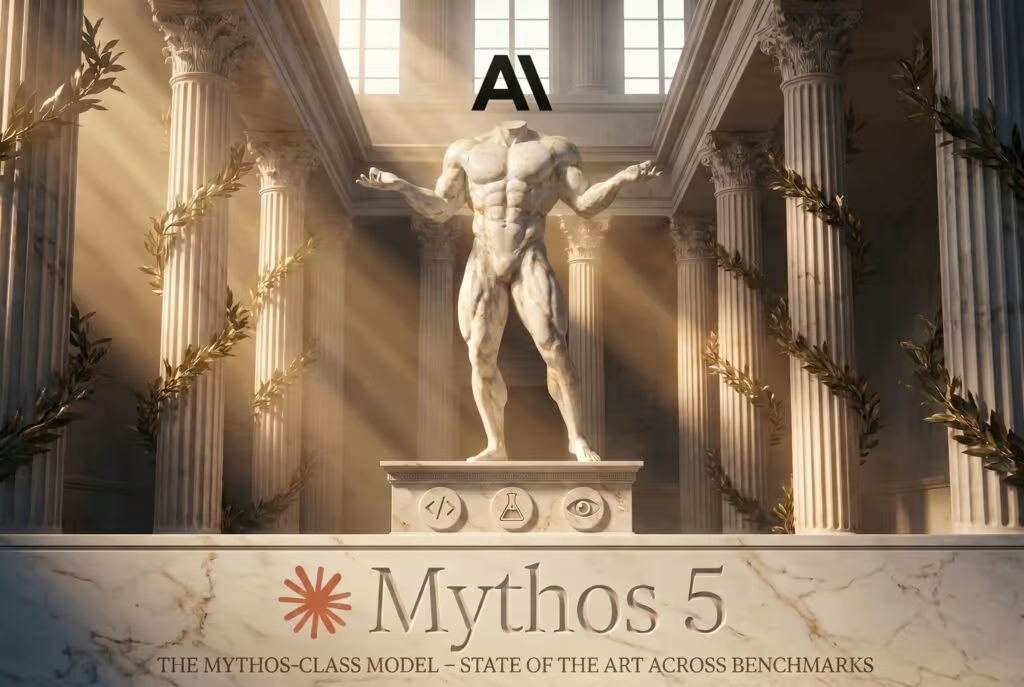
Two of Anthropic’s most advanced AI models, taken offline weeks ago over national security concerns, are coming back, though only part way. According to reporting from Axios and Reuters, US Commerce Secretary Howard Lutnick sent Anthropic a letter dated June 26 easing the export-control directive that had frozen access to the company’s state-of-the-art Mythos 5 and Fable 5 models. The result is a limited, conditional return for Mythos 5, while tighter restrictions on Fable 5 stay in force.
Why It Matters
The episode marks a turning point in how governments treat frontier AI. For years, US export controls focused on the chips and tooling that power AI systems. This action, as Reuters notes, targets access to the AI models themselves, a significant escalation in efforts to limit what foreign parties can use. When a single letter from Washington can switch a leading model off and then partially back on, every business that builds on that model inherits a new kind of risk that has nothing to do with the technology working correctly.
What’s New
Anthropic had received an export-control directive telling it to suspend access to Fable 5 and Mythos 5 for all foreign nationals. In the June 26 letter, Lutnick wrote that Anthropic’s engagement with the government had “yielded significant progress,” and noted that the company “has committed to work with the U.S. government on protocols and standards and releases for the Covered Models.”
On that basis, the letter loosens the rules for Mythos 5. As Lutnick put it, “a license will no longer be required to export, reexport, or in-country transfer (including deemed exports and reexports) the Claude Mythos 5 Model to entities identified in Annex A to this letter and their foreign national employees, or to Anthropic’s foreign national employees.” In plain terms, a defined list of approved organizations can once again use Mythos 5, including their non-US staff, without a special license.
The relief is narrow and revocable. Export controls remain in place for every organization not explicitly approved by the administration, and Lutnick said he reserves the right to change the list of approved entities “at any time.” The precise national security concern behind the original directive was never stated publicly. According to Reuters, it is Anthropic’s understanding that the government believed there was a method of bypassing, or “jailbreaking,” a safeguard meant to prevent Fable 5 from being used to identify software vulnerabilities.
The Numbers
- Two models were affected: Mythos 5 and Fable 5, both suspended for foreign nationals under the original directive.
- June 26: the date of Lutnick’s letter easing controls on Mythos 5.
- One model returns, one stays restricted: Mythos 5 gets a conditional license waiver, while Fable 5 curbs remain.
- Approved entities only: access is limited to organizations named in Annex A and their foreign national employees.
- Revocable at any time: the Commerce Secretary can revise the approved list without notice.
“A license will no longer be required to export, reexport, or in-country transfer… the Claude Mythos 5 Model to entities identified in Annex A to this letter.”
What Comes Next
The partial restoration shows that direct engagement with regulators can reopen access, but it does not settle the underlying tension. Anthropic’s relationship with the government has been strained since the company declined to let the US military use its models for domestic surveillance and autonomous weapons systems. In response, officials placed Anthropic on a supply-chain blacklist, a directive set to take effect later this year. Whether Fable 5 follows Mythos 5 back to market, and on what terms, will depend on further negotiation and on how the administration formalizes its review of frontier models.
Access to a leading AI model is now a policy decision as much as a technical one, and policy can change without warning.
What This Means in Practice
For teams that build products on top of frontier models, the lesson is concrete: the best model available today can be restricted tomorrow for reasons entirely outside your control, then partially restored under conditions you did not set. A model’s uptime now depends on regulatory standing, not just engineering. That argues for portability. Keep prompts, templates, and integrations loosely coupled to any one provider, and keep at least one tested alternative model ready to switch on. Treat any single AI vendor as a potential single point of failure, and design so that a government letter cannot take your whole operation offline.
The Bigger Picture
Frontier AI has moved from a purely technical story into a geopolitical one. Controls that once applied to hardware now reach the models themselves, and access can be granted, revoked, and re-granted through direct correspondence between a company and a cabinet secretary. For everyone downstream, adaptability is becoming a core competency: knowing which models are available, under what conditions, and how quickly you could move if the rules change again. The era of assuming the newest model will simply be there, for everyone, has ended.
FAQ
What did the Commerce Department actually change?
In a letter dated June 26, Commerce Secretary Howard Lutnick eased the export-control directive on Anthropic’s Mythos 5 model. Approved organizations listed in an annex to the letter, along with their foreign national employees, no longer need a special license to use Mythos 5. Restrictions on the Fable 5 model remain in place.
Who can use Mythos 5 now?
Only entities identified in Annex A of the letter, and their foreign national employees, plus Anthropic’s own foreign national employees. Export controls still apply to every organization not explicitly approved, and the Commerce Secretary said he can change the approved list at any time.
Is Fable 5 coming back too?
Not yet. The June 26 letter applies to Mythos 5. Restrictions on Fable 5 remain in force, and any future relief would depend on further engagement between Anthropic and the government.
Run a free scan to see your AI Visibility Score, SEO rating, and local citation accuracy.