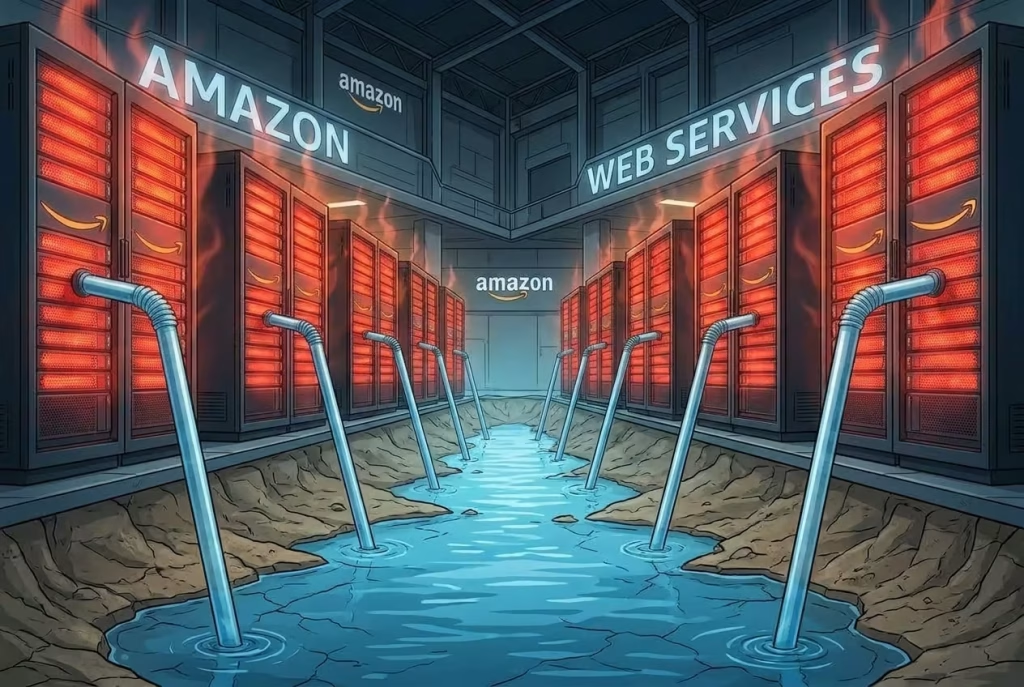
Amazon’s AI data centers consumed approximately 2.5 billion gallons of water over a recent twelve-month period, per the company’s sustainability reporting, a volume large enough to supply a mid-sized U.S. city for a year. The disclosure has put a spotlight on the AI boom’s hidden physical toll: every query, every training run, and every model update travels through a facility that must be cooled, powered, and supplied with water at industrial scale.
Why AI’s Resource Consumption Matters Now
Data centers have always consumed resources, but the AI era has changed the math. Training a single large language model can require clusters of tens of thousands of GPUs running continuously for months. Heat density inside those racks now routinely exceeds 30 kW per rack, triple what a traditional enterprise server room produces, and the cooling systems required to keep chips from throttling or failing have become a first-order engineering constraint, not an afterthought.
The International Energy Agency estimates global data center electricity consumption could reach 1,000 terawatt-hours by 2026, more than double the 2022 figure of roughly 460 TWh. In the United States, data centers already account for about 2.5% of total national electricity demand, a share projected to rise to between 6% and 9% by 2030 as AI workloads expand. Water use tracks upward alongside power: the U.S. Department of Energy’s Lawrence Berkeley National Laboratory found that mid-sized data centers can consume 300,000 to 500,000 gallons of water per day for cooling alone during peak summer operations.
Those numbers make water a strategic variable, especially in regions already facing scarcity. Northern Virginia, home to the world’s largest concentration of data centers, sits within the Potomac River watershed. Phoenix, another major data center corridor, relies on the Colorado River basin. The tension between AI expansion and water availability is no longer hypothetical.
What’s Actually Driving AI’s Water and Power Appetite
The resource footprint splits into two categories: direct on-site consumption (cooling, humidification, facility operations) and indirect consumption (water used to generate the electricity feeding the facility). For most large AI data centers, the indirect side, the power-generation water footprint, often exceeds direct cooling use, because thermal power plants (coal, nuclear, natural gas) consume substantial water per megawatt-hour produced.
On-site, the dominant factor is cooling. Modern GPU clusters, NVIDIA H100 and upcoming B200 accelerators, pack staggering compute density into compact server sleds. A single H100 GPU can draw up to 700 watts, and a server node with eight such GPUs runs hot enough to require liquid cooling rather than traditional air handlers. As models scale and training runs stretch across weeks, maintaining stable chip temperatures is non-negotiable; thermal throttling can add millions of dollars in compute time.
Water enters the picture through evaporative cooling towers, which reject heat by evaporating a portion of the water, removing it from the local watershed. Some facilities use closed-loop chilled water systems that recirculate, but evaporative losses remain the largest direct water sink for most large-scale AI campuses. A 2023 analysis published in Communications of the ACM estimated that training GPT-3-level models can indirectly consume 700,000 liters of water (about 185,000 gallons) at the least efficient data centers, comparable to the lifetime water footprint of manufacturing several automobiles.
The Numbers: AI’s Environmental Footprint at a Glance
- 2.5 billion gallons of water consumed by Amazon’s AI data centers over a twelve-month period, per the company’s own sustainability disclosure (Amazon Sustainability Report).
- 460 TWh of electricity consumed by global data centers in 2022, with AI workloads growing as a share of total capacity (International Energy Agency).
- 700,000 liters (~185,000 gallons) of water potentially consumed when training a single large language model, depending on data center efficiency and regional power mix (Ren et al., Communications of the ACM, 2023).
- 300,000-500,000 gallons per day consumed by a typical mid-sized data center for cooling during summer peaks (Lawrence Berkeley National Laboratory, U.S. DOE).
- The average hyperscale data center can use 1-5 million gallons per day, with the largest AI-training campuses pushing toward the high end of that range year-round.
“Addressing the water footprint of AI requires transparency, efficiency innovation across the entire lifecycle, from chip design to cooling system selection, and siting decisions that respect local watershed constraints.”
Every AI query carries a hidden water cost. Data centers now consume billions of gallons annually to keep the models running, and the bill is coming due.
How the Industry Is Responding: Liquid Cooling, Recycling, and Smarter Siting
Chipmakers and cloud operators are not sitting idle. Direct-to-chip liquid cooling has moved from experimental to default in new high-density AI clusters. NVIDIA’s latest reference architectures specify liquid cooling as standard for B200 deployments. Microsoft, Google, and Amazon are all investing heavily in closed-loop and waste-water recycling systems that treat and reuse cooling water multiple times before discharge.
Amazon Web Services has committed to being water-positive by 2030, returning more water to communities than it consumes, through a combination of on-site recycling, rainwater harvesting, and replenishment projects in water-stressed regions. Google published water use efficiency (WUE) metrics showing its global fleet averages 0.24 liters of water per kWh of IT equipment energy, and the company has moved several facilities to air-cooling or recycled-water systems in drought-prone geographies.
The other lever is siting. New AI data center campuses are increasingly located near dedicated renewable generation, solar and wind farms paired with battery storage, which reduces the indirect water footprint from thermal power plants. Nordic countries, with abundant hydropower and naturally cool ambient air, have attracted major AI training clusters for this reason. Microsoft’s undersea data center experiment (Project Natick) demonstrated the viability of passive ocean-water cooling, eliminating evaporative losses entirely, though that approach remains niche.
Chip efficiency gains provide a partial offset. Each generation of AI accelerator delivers more performance per watt: NVIDIA’s B200 roughly doubles the performance of the H100 within a similar power envelope. But efficiency improvements have historically been outpaced by demand growth, a dynamic known as Jevons paradox, where cheaper compute drives more total consumption rather than less.
What Comes Next: Transparency, Regulation, and Competition for Resources
The European Union’s Energy Efficiency Directive now requires data center operators above 500 kW to report energy and water performance publicly. In the U.S., the SEC’s climate disclosure rules push large public companies toward standardized environmental reporting, though water metrics remain less granular than carbon metrics. Several U.S. states are reevaluating data center tax incentives to account for water consumption, with Virginia and Arizona both conducting water-impact studies for proposed developments.
On the technology side, immersion cooling, submerging entire servers in dielectric fluid, promises lower water use than evaporative systems, and several hyperscalers are piloting it at scale. AI itself is being deployed to optimize cooling loops, dynamically adjusting flow rates and temperatures based on real-time workload signals, squeezing 10-20% efficiency gains from existing infrastructure.
Competition for water access may reshape the map. Municipalities that once courted data centers for property-tax revenue are now weighing water allocation more carefully. The industry’s ability to decouple growth from water consumption, through liquid cooling, non-potable water sourcing, and renewable-sited facilities, will determine how frictionless its expansion can be.
What This Means for You
If you run a business that depends on AI tools, whether for content, customer service, lead analysis, or search visibility, this infrastructure story matters to your bottom line, even if you never step inside a data center. The cost of compute, cooling, and power ultimately shapes the pricing of every AI service you subscribe to. When water and energy constraints slow capacity expansion or increase operational overhead, those costs flow downstream.
Understanding the physical backbone behind AI also sharpens your judgment when evaluating providers. A vendor that builds on efficient, sustainable infrastructure is less exposed to future resource-related price volatility. As models grow larger and inference becomes more ubiquitous, powers AI-driven search, agent interactions, and AI contactability scoring, the infrastructure demand will only intensify. For a deeper look at how data center innovation could reshape AI search performance, see our coverage of orbital AI data centers and what they mean for latency and local relevance. And if you’re curious how multiple AI models work together, each running on its own set of physical resources, our piece on AI model fusion explains why infrastructure decisions ripple through the quality of AI-generated answers about your business.
More broadly, businesses that factor sustainability, both their own and their technology partners’, into procurement criteria will be ahead of regulations that increasingly hold companies accountable for Scope 3 emissions, which include cloud computing. For ongoing coverage of AI infrastructure and its impact on how your business gets found, visit our blog.
The Bigger Picture
AI’s water and energy appetite is a growth-phase reality, not a permanent flaw. The same engineering talent that produced today’s models is now turning toward efficiency, better chips, smarter cooling, and data centers that recycle rather than consume. But the scale is vast, the growth curve steep, and the resource competition real. The companies and communities that treat water and power as first-class design constraints, not externalities, will build the AI infrastructure that lasts. For everyone else, the hidden environmental costs of intelligence, measured in gallons and gigawatt-hours, will become harder to ignore.
FAQ
Why do AI data centers use so much water?
AI data centers use water primarily for cooling the high-density GPU clusters that train and run large models. Modern AI accelerators like NVIDIA H100 GPUs generate enormous heat, and evaporative cooling towers reject that heat by evaporating a portion of water. Additionally, the electricity powering these facilities often comes from thermal plants (coal, nuclear, natural gas) that themselves consume water, creating an indirect water footprint that can exceed direct on-site use.
How much water does training a single large AI model consume?
According to a 2023 analysis published in Communications of the ACM, training a GPT-3-level model can indirectly consume roughly 700,000 liters of water (about 185,000 gallons) at the least efficient data centers. Actual figures vary with regional power mix and cooling efficiency.
What is the industry doing to reduce data center water use?
Major cloud operators are pursuing multiple strategies: AWS has committed to being water-positive by 2030 through recycling and replenishment; Google publishes water use efficiency metrics and uses non-potable and recycled water at many sites; Microsoft’s Project Natick explored ocean-water cooling; and all major players are adopting direct-to-chip liquid cooling to cut evaporative losses.
Sources
- Amazon Sustainability Report
- IEA Data Centres and Data Transmission Networks
- Li, Ren, et al. ‘Making AI Less Thirsty.’ Communications of the ACM, 2023.
- Lawrence Berkeley National Laboratory Data Center Research
Related coverage
Run a free scan to see your AI Visibility Score, SEO rating, and local citation accuracy.