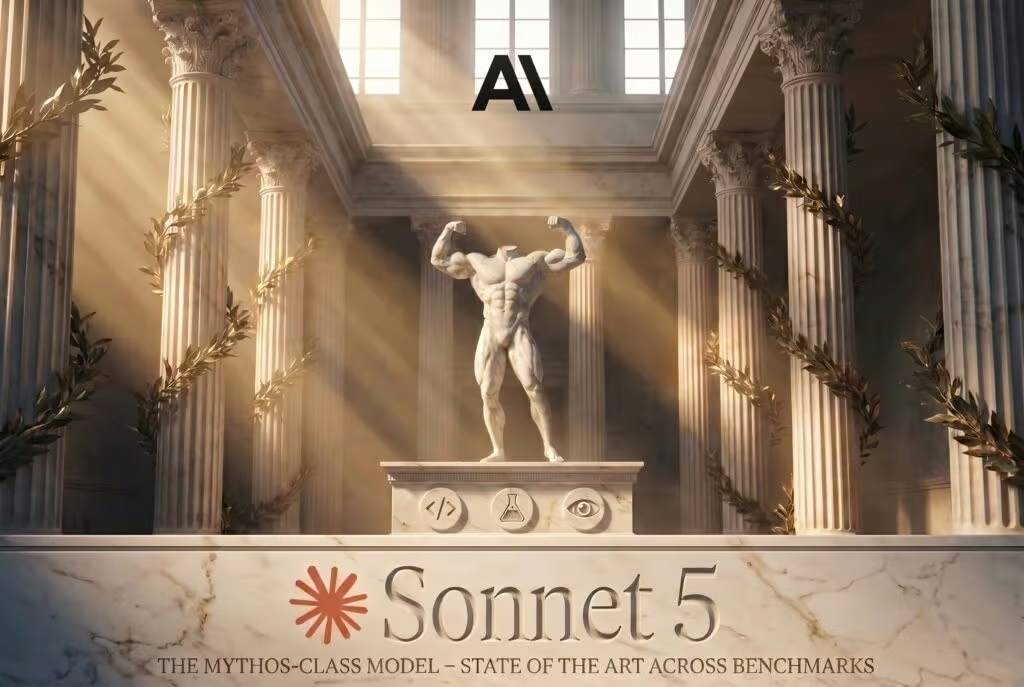
Anthropic released Claude Sonnet 5 this week, positioning it as a cheaper, faster counterpart to Opus 4.8 in what amounts to a relatively incremental update despite the version-number jump. Public attention, however, is fixed on the broader policy environment: fresh debate over the so-called Mythos Moment, the arrangements under which American institutions now access the more capable model, and a cascade of legal and regulatory questions the industry cannot answer on its own.
What Does the U.S.-China Regulation Comparison Reveal?
The United States currently restricts its own frontier AI more than China restricts its own frontier systems. That comparison only goes so far: when the U.S. frontier was at a comparable level, its developers faced far fewer constraints. The gap reflects how tightly regulation tracks capability. If your systems produce results similar to those of Chinese labs, the regulatory pressure is light. As capability rises, so does the pressure.
This does not validate every new American restriction, but it does recast the debate. Critics of domestic policy should weigh their objections against the alternative: a lighter-touch regime that has not prevented China’s leading labs from pushing forward.
What Happened With the DeepMind Pentagon Contract?
Google DeepMind reportedly built its reputation on a strong safety culture and trusted leadership rather than on formal governance structures. A recent commentary argues that this approach has now been stress-tested and found wanting. The Pentagon contract was signed with enough ambiguous language that the government retains broad latitude to direct how the technology is used.
The internal letter signed by roughly 600 employees did not change the outcome. Without a willingness to strike or resign, employee leverage in such negotiations remains limited. That is the central argument behind union recognition efforts at DeepMind: collective representation would give staff a viable mechanism to back up stated objections with action.
How Does the AI Incident Reporting Act Define Covered Models?
The AI Incident Reporting Act, introduced by Representative Nate Moran (R-TX), takes a different approach from earlier proposals. Coverage is keyed to a capabilities-based threshold for what counts as a covered model, which is technically tricky but offers a more durable definition than compute thresholds alone. Preemption is handled in a way that several legal analysts consider sound. The bill is one of the more carefully scoped attempts to require incident reporting without freezing the broader frontier.
Do ‘Good Guy With a Gun’ Analogies Hold Up in AI Policy?
The “good guy with a gun” framing has migrated into AI policy conversations. The argument is that ensuring the good guys have access to the same powerful models will prevent harm. The premise is weak. A world in which attackers and defenders operate with identical tools is not the safest world. It is better than the alternative where attackers hold superior tools, but it leaves plenty of room for damage before defenders patch and respond.
Historically, attackers faced a talent constraint. Most people did not want to be the bad actor. If AI reduces the talent required to mount sophisticated operations, and the financial incentives remain, that constraint weakens fast. Open-weight releases at best produce parity, which still leaves real risks.
Defensive advantage is not automatic. Optimism about defense prevailing “at the limit” depends on active work to shift the balance, including through better tools, better detection, and policy choices that give defenders a head start.
Why Is the Judiciary Becoming the Central AI Policy Arena?
AI policy in the United States has, to this point, been largely an executive-branch story, with Congress unable to legislate. The judiciary now looks like the arena where the most consequential fights will play out. Courts can move quickly, and a few well-chosen cases could redirect the entire trajectory.
The First Amendment is the most likely vehicle. Legal thinkers are beginning to argue that frontier AI creation, distribution, and use should be treated as protected expression, with implications for who has standing and what fact patterns will be heard. This is a step beyond the older “code is speech” argument.
There is a reasonable counterpoint: if First Amendment protections fully apply to frontier models, then softer regulation becomes harder to enact. That tension is real, but it is not a reason to abandon the constitutional questions. Sovereignty in a democracy ultimately rests with the people, which means accepting that some controls on powerful systems may need to coexist with constitutional limits.
There is also a practical question. Courts in the United States have historically tolerated a number of regulatory practices that are at the edge of the First Amendment’s text. If the courts ever tried to enforce the amendment’s literal scope across the board, the result would be politically infeasible. Predictions about how this will play out should account for that.
What Happens if Courts Treat AI Models as Speech?
A new round of argument treats the AI model itself as protected speech. The reasoning is that the user supplies the entire context window, every prompt and every prior response, and that constraining how someone uses a language model amounts to regulating expressive conduct.
The argument is not absurd on its face, but it carries implications its proponents often understate. If courts accepted the full version of this claim, the natural government response would not be surrender. It would be to restrict the training, deployment, and physical distribution of sufficiently capable models rather than attempt to control how they are used. Authorities use whatever tools remain available. Taking away one lever does not end the regulatory project. It shifts the project to another lever.
That is not a descriptive prediction about how a government facing severe risks from unrestricted frontier systems would behave if direct use restrictions were struck down.
How Does Slaughter v. Trump Affect AI Regulators?
The Supreme Court’s ruling in Slaughter v. Trump, which overruled Humphrey’s Executor on a 6-3 vote, ended a long-standing precedent protecting certain agency officials from at-will presidential removal. Going forward, the President can fire, for any reason, officers involved in substantive rulemaking, investigations, enforcement, civil litigation, and in-house adjudication at most independent agencies. The Federal Reserve remains a special case for historical reasons.
For AI policy, the implications are direct. A Frontier AI Commission with the power to license major training runs, compel evaluations, restrict deployments, order emergency pauses, and impose penalties would, under this decision, have leaders removable at the President’s discretion. The Court explicitly rejected the technocratic argument that functional independence justifies structural protection.
One view is that this is clarifying: agencies like the FTC and SEC have always been political, and the ruling simply acknowledges that. The opposing view is that even the fiction of nonpartisanship in those agencies serves a valuable function, limiting how directly they can be wielded as partisan instruments. Without that buffer, the tools of financial, consumer, and speech regulation become more readily available for political purposes.
The practical effect for AI is that any independent expert body capable of evaluating frontier models and imposing binding consequences looks harder to construct, at least through ordinary legislation. Other paths, including judicial enforcement or state-level activity, may attract more attention as a result.
Where Does This Leave Open-Weight Models?
A separate current thread in the policy world concerns open-weight releases. Critics argue that open-weight frontier models are categorically unsafe because once released, weights cannot be recalled. The argument has a strong version and a weak version, and they often get conflated.
Banning the publication of model weights raises its own First Amendment question, which connects back to the broader judicial turn described above. It also raises export-control and national-security questions that touch on entirely different statutory regimes. A serious policy response has to grapple with both the speech dimension and the proliferation dimension rather than collapsing them into one.
None of these questions will be resolved quickly. The week’s developments, from a quieter Anthropic release to a major constitutional ruling, are best read as the next chapter in a longer process. The frontier labs, the courts, the executive branch, and outside commentators will all be adjusting their strategies for some time to come.
FAQ
What is Claude Sonnet 5 and how does it compare to Opus 4.8?
Anthropic released Claude Sonnet 5 this week as a cheaper, faster counterpart to Opus 4.8. It is positioned as a relatively incremental update despite the version-number jump, and outside testers are still forming a clear picture of how it behaves across coding, reasoning, and long-context tasks.
Why does Slaughter v. Trump matter for AI policy?
The Supreme Court’s 6-3 ruling in Slaughter v. Trump overruled Humphrey’s Executor, allowing the President to fire officers at most independent agencies for any reason. A Frontier AI Commission with powers like licensing training runs, restricting deployments, or ordering emergency pauses would have leaders removable at the President’s discretion, making independent expert bodies harder to construct through ordinary legislation.
Could frontier AI models be treated as protected speech?
Legal thinkers are beginning to argue that frontier AI creation, distribution, and use should be treated as protected expression under the First Amendment, going beyond the older “code is speech” argument. Critics note that if courts accepted this fully, the natural government response would shift to restricting the training, deployment, and physical distribution of sufficiently capable models rather than how they are used.
Related coverage
Run a free scan to see your AI Visibility Score, SEO rating, and local citation accuracy.