Counseling Services for Wellbeing – Smokey Point
 Run a free full audit
Contact Information
-
Address
3402 173rd Pl NE Suite 201
Arlington, WA 98115 -
Phone
(360) 215-2020 -
Website
counselingwellbeing.com -
Google Reviews
3.4 out of 5 stars from 7 Google reviews
Location
About Counseling Services for Wellbeing – Smokey Point
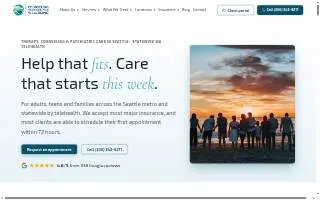
Counseling Services for Wellbeing is a psychiatrist practice in Arlington, WA, operating as one of three in-person offices for the broader Seattle metro area. The practice provides integrated mental health care for adults, teens, and families, combining talk therapy and psychiatric services under one roof. Specific services include individual, couples, and family therapy, as well as psychiatric evaluations, medication management, and ADHD care for children, teens, and adults. Clinicians are trained in a variety of approaches, including EMDR, DBT, CBT, Gottman, EFT, IFS, and somatic methods. The practice accepts most major insurance plans and typically schedules first appointments within 72 hours. Clients can also access care via secure video telehealth anywhere in Washington state. The practice holds a rating of 3.40 based on 7 reviews.
The practice was co-founded by clinical director Issy Kleiman, LMFT, on the principle that therapy and psychiatry should be coordinated directly rather than requiring patients to manage separate offices. Kleiman has over 27 years of experience in mental health and currently provides clinical supervision and mentorship. The team includes 57 therapists and 15 psychiatric providers, with specialties ranging from anxiety and trauma to depression, grief, and substance use. The holistic, integrative model focuses on treating the whole person across emotional, physical, and spiritual domains, ensuring that the therapist and psychiatric provider share the same intake, team, and chart.
Located at 3402 173rd Pl NE Suite 201, the office sits on 173rd Pl NE in the Smokey Point neighborhood. It is about a tenth of a mile from the Smokey Point Transit Center and Smokey Point Boulevard. The location is roughly a quarter of a mile from the Arlington Police station and the Ace's Casino. The Smokey Point Sno Isle Library is also nearby, at about a third of a mile from the practice.
Counseling Services for Wellbeing serves the Arlington and Seattle metro areas by offering coordinated care that eliminates the need for patients to carry messages between separate therapy and psychiatry providers. This integrated approach allows for a unified treatment plan where clinical supervision and direct care are managed within a single practice structure.
Score Summary
BizScoreAI scanned the website counselingwellbeing.com on July 17, 2026. Counseling Services for Wellbeing - Smokey Point has a BizScore of 76 out of 100.
- AI Visibility70 out of 100
- SEO81 out of 100
- Google rating3.4 out of 5
AI visibility scan by category: AI Discovery 25 of 25 points, Structured Data 10 of 25 points, Content Readiness 30 of 30 points, AI Trust Signals 11 of 20 points.
Website audit sub-scores (out of 100): On-Page 83, Technical 90, Performance 72, Content 78.
Strengths: 10 checks passed. llms.txt, AI Crawler Access, AI Content Blocking, FAQPage Schema, LocalBusiness Schema, Hyperlocal Targeting, Q&A Content, AI-Parseable Headings, About/Team Page, XML Sitemap.
Areas to improve: 7 checks. Google Business Profile Link (failed), Third-Party Review Links (failed), Organization Schema (warning), Speakable Schema (warning), Local Multimedia (warning), Meta Description (warning), Author Signals (warning).
More Businesses in Arlington, Washington
- Chiro One Chiropractic & Wellness Center of ArlingtonBizScore 74
- Arlington PharmacyBizScore 74
- All StarZ Staffing & Consulting, LLC of ArlingtonBizScore 70
- Defensive Driving School of Smokey PointBizScore 70
- Pilchuck Periodontics & ImplantologyBizScore 68
- Hoekema Homestead GoldensBizScore 67
- A HUGE Production of ArlingtonBizScore 65
- SERVPRO of Marysville / ArlingtonBizScore 65
- Advanced Care Animal Clinic of ArlingtonBizScore 65
- Julz Animal Houz Marysville of ArlingtonBizScore 64
Browse: Businesses in Arlington, WA · Psychiatrist in Washington · Businesses in Washington
AI engine reads
Read by AI engines 5 times in the last 30 days.
Counted from AI crawler and assistant visits to this page, identified by user agent.
See the full AI visibility report for this businessContact Counseling Services for Wellbeing – Smokey Point
Ways to improve this score
Run a free full auditWe improve your AI Visibility, SEO, and Local SEO scores as far as your current website allows.
Boost This Listing
Get a gold badge, photo gallery, and more.