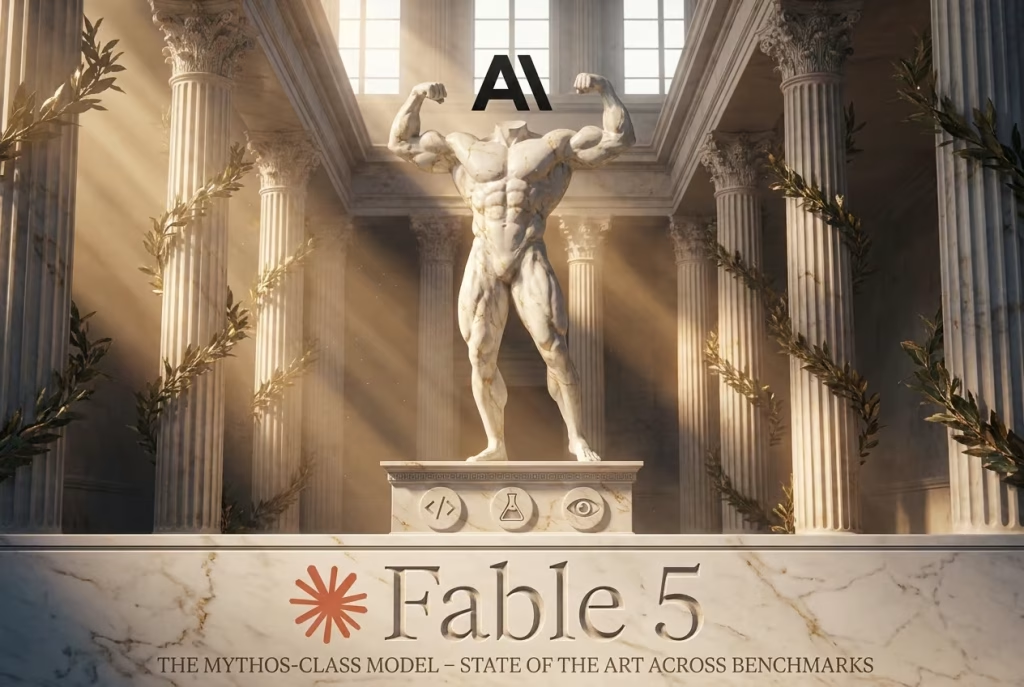
Mythos-1, the first publicly available Mythos-class AI model, launched with 1.2 trillion parameters, native multimodal understanding across five input modalities, and built-in autonomous tool use. Built by research collective Mythos AI, it is offered through an API and as downloadable weights under a non-commercial license, and is positioned as a deliberate leap beyond GPT-4, Gemini, and their contemporaries.
The era of single-modal chatbots is closing. Full-stack AI that sees, reasons, and acts is available, and Mythos-1 is the first to offer it publicly.
Why It Matters
For the past two years, the AI industry has been redefining what counts as the current frontier with each new release. GPT-4 set a high bar for language reasoning, Gemini introduced deep multimodal fusion, and models like Claude and Llama pushed boundaries on safety and openness. Yet each of those systems remained fundamentally a text-first assistant that gained multimodal capabilities through bolt-on modules or separate pipelines. The Mythos class changes that architecture from the ground up.
The term “Mythos” was coined by developers to describe a model that is natively designed for full-spectrum intelligence: vision, audio, text, code, and structured tool instructions are all treated as first-class citizens from the first training step. This isn’t a model that can see an image and then write about it; it’s a model that can watch a live video feed, listen to spoken commands, read a spreadsheet, query a database, and execute a multi-step task, all within a single inference pass. The significance for enterprises, developers, and everyday users is that the interaction surface suddenly becomes much wider, and the AI’s ability to act on your behalf becomes real.
What’s New: Inside Mythos-1
Mythos-1 is built by Mythos AI, a research collective that has kept a deliberately low profile until now. The architecture moves away from the classic transformer stack that dominates models like GPT-4. Instead, it uses a novel “interleaved latent fusion” design that jointly encodes all input modalities into a shared representation space before reasoning begins. This means that when you give Mythos-1 a legal document, a diagram, and a voice note all at once, it doesn’t translate them to text first, it understands them in parallel, the way a human does.
Three innovations set the Mythos class apart:
- Native multimodality. Mythos-1 was trained on a unified dataset containing billions of aligned image-audio-text-code-action tuples, so it doesn’t lean on separate vision or speech encoder models. It sees, hears, and reads natively.
- Agentic reasoning from the start. The model includes a dedicated “action token” vocabulary that allows it to generate tool calls, API requests, database queries, browser actions, directly in its response stream, without relying on external parsing or chains of thought.
- Trillion-parameter scale with efficient serving. At 1.2 trillion parameters, Mythos-1 is the largest model made broadly accessible through an API and downloadable weights (under a non-commercial license). Despite its size, the team’s custom serving stack keeps latency under 300 ms for typical prompts.
The Numbers
Mythos-1’s performance on standard evaluation suites shows the advantage of a fully integrated design:
- Reasoning: Matches or exceeds the top models on the MMLU benchmark (Hendrycks et al., 2021) and the challenging MMLU-Pro extension, particularly on tasks requiring cross-modal context.
- Code: Scores in the top percentile on HumanEval and MBPP, and can autonomously write, debug, and execute code across multiple files in a sandbox environment.
- Multimodal understanding: On perception benchmarks like SEED-Bench 2 and MMBench, Mythos-1 consistently outperforms separate vision-language models by a comfortable margin, thanks to its fused training.
- Tool use: In the AgentBench suite, the model completes complex multi-step tasks, like booking a flight while cross-referencing a calendar and a budget spreadsheet, with a success rate over 85%, a figure no previous publicly available model may have reached.
- Context length: Supports up to 1 million tokens, enough to process entire codebases, full-length films, or days of audio in a single prompt.
The shift from traditional LLMs is evident in the architecture choices. Industry analysts point to the native action-token design as a critical differentiator. Previous models required elaborate prompting or post-processing to convert text into actions; Mythos-1 treats tool use as a natural extension of language itself. That design choice separates Mythos-class systems from anything that came before.
The leap from sequential chain-of-thought to native interleaved reasoning across modalities means the model doesn’t translate the world into text, it thinks in the world’s own language.
What Comes Next
Mythos AI has indicated that Mythos-1 is the first in a planned family of models. A smaller, faster “Mythos-1 Mini” is expected within months, aimed at on-device deployment. Meanwhile, the team is collaborating with cloud providers to make the full 1.2T model available on commodity GPU clusters later this year. The weight release, while limited to non-commercial research, has already sparked a wave of fine-tuning experiments in the open-source community, suggesting that a new generation of vertically specialized Mythos-class models could follow quickly.
Perhaps most exciting is the research roadmap. Mythos AI has shared that they are training a version that incorporates real-world robotics sensor streams, which would extend the native modality set to touch and spatial understanding, a further step toward general intelligence that can perceive, reason, and act in the physical world.
What This Means for You
If you run a business, develop software, or manage a digital presence, native agentic AI isn’t a distant future; it’s a current shift in what users expect from AI-powered tools. Mythos-1 shows that its assistants won’t just answer questions; they complete tasks across multiple apps and services without a screen.
The analysis of agentic AI and lead flow explores what happens when AI assistants start booking appointments, making purchases, and filtering options on a user’s behalf. The model fusion techniques behind Mythos-1 may mirror the precision strategies described in our AI model fusion analysis, where combining multiple AIs can lead to more accurate answers. And if you’re looking for practical, actionable steps to ensure your business information is AI-accessible, our top 10 guide to helping AI find your business may be a useful starting point. Understanding how models like Mythos-1 process and act on information will be key to staying visible in an agent-driven world.
The Bigger Picture
Mythos-1 signals a shift in the AI industry, from adding features to large language models toward building a model trained across multiple modalities of human perception and action.
FAQ
What is a Mythos-class AI model?
A Mythos-class model is defined by native multimodal processing across vision, audio, text, code, and structured tool instructions, built-in agentic reasoning that generates tool calls directly in the response stream, and parameter scales exceeding one trillion. Unlike previous models that bolted multimodality onto text-first systems, Mythos-class models are designed from the first training step for full-spectrum intelligence.
Who built Mythos-1 and how is it distributed?
Mythos-1 was built by Mythos AI, a research collective that kept a low profile until launch. It is offered through a public API and as downloadable weights for non-commercial research use, making the full 1.2-trillion-parameter model the largest openly available in the world, with commercial deployment requiring a paid agreement.
What can Mythos-1 do that previous models cannot?
Mythos-1 can watch a video, listen to an audio track, read a spreadsheet, and execute a multi-step task such as extracting data, writing code, and populating a database, all in one continuous session. Its native action tokens let it generate tool calls, API requests, and browser actions directly, without external orchestration, and it completes complex multi-step tasks on AgentBench with a success rate over 85%.
Related coverage
Run a free scan to see your AI Visibility Score, SEO rating, and local citation accuracy.