
The book gives readers a method for turning a business’s expertise into sourced content that AI platforms can cite. A business can publish useful content and rank for relevant keywords yet still be absent from AI platform recommendations, so the gap usually lies in credibility rather than visibility.
What Brand Authority Means in AI Search
Brand authority is the credibility a business establishes around its expertise, services, and industry. For AI search, the practical question is whether the information available online clearly connects the company to relevant topics and supports the claims made about it. No single universal authority score is shared by every AI platform, so a brand may appear for one question and disappear for another because the context, available sources, and generated response differ each time. Three useful outcomes to separate are being mentioned, having a page cited, and being recommended, and each tells a different story about how the brand is being represented.
Step 1: Identify the Topics Your Brand Should Own
Most prompts research starts with popular questions users might ask. A more useful starting point is the business itself: which services matter most, who needs them, and what questions come up before someone makes an inquiry. An agency offering SEO, for example, should demonstrate its expertise through topics such as technical SEO audits, website performance optimization, content strategy, and search visibility analysis. Covering these areas gives the positioning depth and shows the practical expertise behind the services. Prompt Research tools help explore questions around these services, while Competitor Research identifies topics and prompts where competing brands appear and the business does not. Each opportunity is reviewed against actual capabilities, and only prompts where the business can answer well and where appearing could influence a meaningful buying decision earn attention.
Step 2: Make Your Brand Identity Consistent
Before adding new content, the existing information should tell a coherent story. The homepage, About page, service pages, author profiles, and external listings should consistently communicate the company’s name, services, locations, and areas of expertise. Consistency does not require identical wording across every page, only that the facts be compatible. A company positioning itself as an enterprise specialist should have service details and project evidence that support that positioning. Common trouble spots include outdated profiles, discontinued services, conflicting addresses, and vague descriptions, all of which can confuse customers and leave conflicting information about the company available online. A simple practical test: after reviewing these pages, could someone unfamiliar with the company clearly explain what it does, who it serves, and what demonstrates its expertise?
Step 3: Publish Content That Demonstrates Expertise
Publishing more articles is easy. Demonstrating genuine knowledge takes more work. The focus belongs on questions where the business can offer experience-based insights such as how a process works, what affects costs, when a service is appropriate, or which limitations buyers should understand. The answer should reflect experience rather than repeat what competing articles already say.
Turn Experience Into Evidence
Useful evidence includes documented case studies, original research, expert explanations, and examples from completed work. A case study should explain the problem, approach, result, and relevant constraints, with enough context for readers to understand what happened and whether the experience applies to their situation. Research should include the methodology, sample, and date. Expert guidance should identify the contributor and relevant qualifications. This creates material worth referencing while giving customers a clearer basis for evaluating the brand.
Connect Supporting Content to Your Services
Informational content should help readers understand the company’s relevant expertise without turning every article into a sales pitch. A migration guide can link to an enterprise service page, which can then connect readers to relevant case studies and specialist profiles. Connections should help people continue their research, and each page should have a clear purpose with supporting links that make the relevant expertise and evidence easier to discover.
Step 4: Earn Relevant Third-Party Recognition
The company website explains its own claims. Independent coverage offers another perspective and additional context about expertise. Opportunities worth pursuing include expert commentary, original research, interviews, industry association resources, and detailed customer reviews. Competitor and source analysis helps identify where competing brands are being mentioned or cited, and each page is reviewed directly to assess relevance, audience, and editorial quality. A cited source is a research lead, not an automatic outreach target, so the question is whether its audience is relevant to the business and whether the brand has a legitimate reason to contribute. Honest customer feedback that describes the service, experience, and outcome provides more useful context than generic praise.
Step 5: Make Your Evidence Easy to Find and Understand
Strong evidence loses value when visitors cannot easily find it or understand what it proves. Direct answers belong near the beginning of relevant sections, with descriptive headings and technical terms explained when needed. Important qualifications should appear alongside the claims they clarify. Comparisons should clearly state the criteria being used. Statistics should include the source and publication date. Service claims should link to relevant supporting examples where available. A technical audit of important pages also helps identify issues that could affect how easily users and search engines access or navigate the information. Accessibility supports authority work, but a technically accessible page still needs accurate information, clear context, and meaningful evidence to establish credibility.
Step 6: Measure Whether Your Authority Work Improves Visibility
A baseline should be established before making substantial changes so there is a clear point of comparison. Visibility Overview helps assess existing presence, Brand Performance provides Share of Voice, sentiment, and narrative analysis, and Prompt Tracking monitors selected questions over time. Prompts should be tied to core services and buying decisions, and the same set maintained for comparison. Patterns worth watching include more relevant mentions, citations to stronger pages, clearer descriptions of the brand, and changes in visibility relative to competitors. These are indicators, not proof that a specific content update caused a change. Completed work should be documented alongside visibility trends and relevant business outcomes so reporting stays grounded and results can be interpreted in context.
Common Brand Authority Mistakes
- Do not claim expertise without supporting evidence. Unless surrounding content supports them, words such as trusted or leading add little value.
- Media coverage helps when a publication’s readers match a business’s customers and the article accurately describes what the business sells.
- Filling the website with overlapping articles. Multiple thin pages that answer essentially the same question can make the site harder to navigate without adding meaningful information or evidence.
- Treating a single favorable AI response as proof of success. AI-generated answers can vary, so a consistent set of prompts should be monitored over time.
FAQ
What is brand authority in AI search?
Brand authority in AI search is the credibility a business builds around its expertise, services, and industry, depending on whether online information links the company to relevant topics and supports the claims made about it. Each AI platform uses its own authority score, and no single score carries over between them.
How do you build brand authority for AI search?
Identify the topics the business can genuinely speak to, make its identity and expertise consistent across its digital presence, publish evidence that demonstrates what it knows, earn relevant third-party recognition, make evidence easy to find, and measure visibility changes against a consistent set of prompts over time.
What are common brand authority mistakes?
Common mistakes include claiming expertise without evidence, pursuing every mention regardless of relevance, filling the site with overlapping thin articles, and treating a single favorable AI response as proof of success instead of monitoring a consistent set of prompts.
SEOScanPro
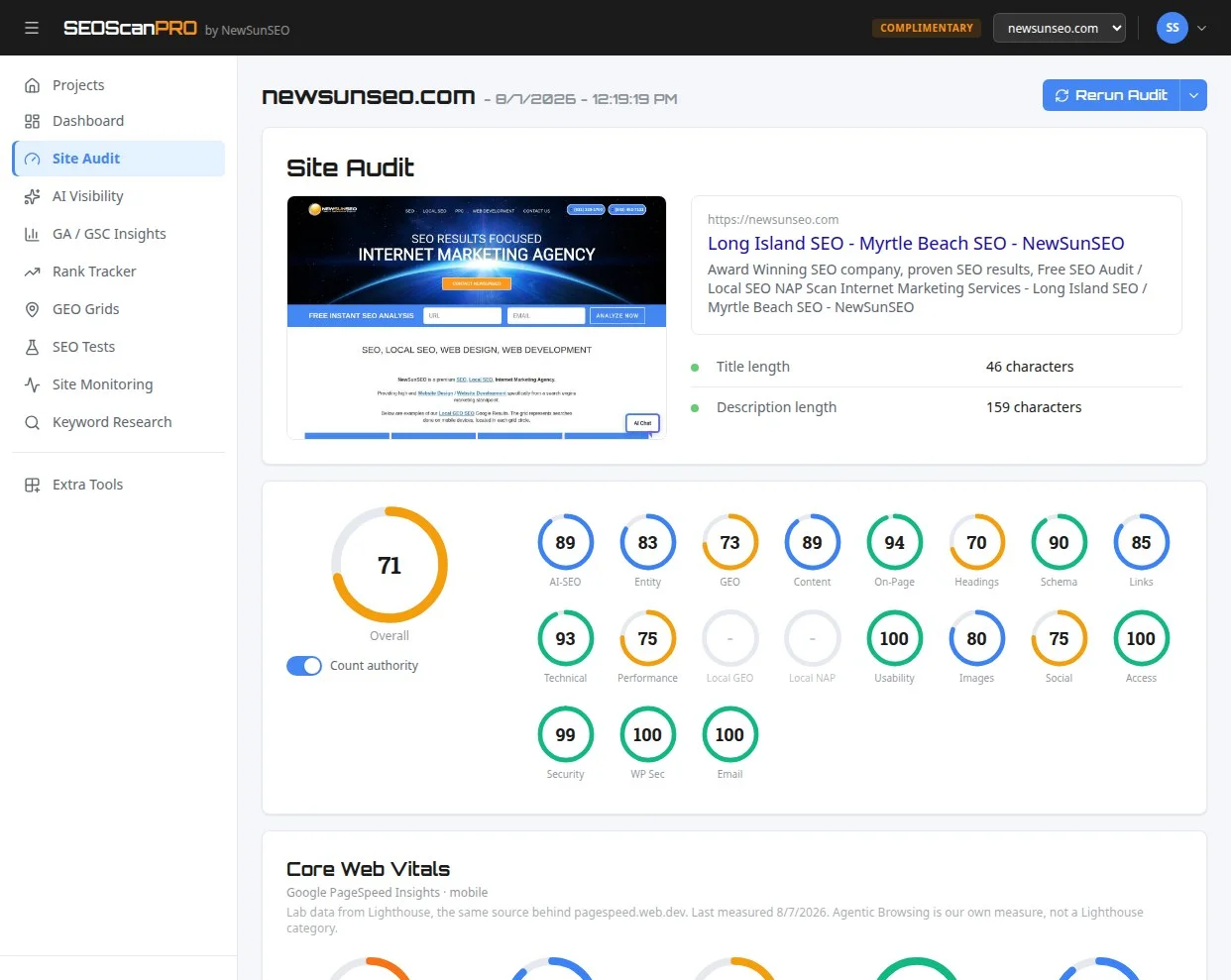
SEOScanPro runs a full technical audit of a site and shows the measured result behind every check. Open the site audit tool.
See our editorial disclaimer for how our articles are produced.
Run a free scan to see your AI Visibility Score, SEO rating, and local citation accuracy.