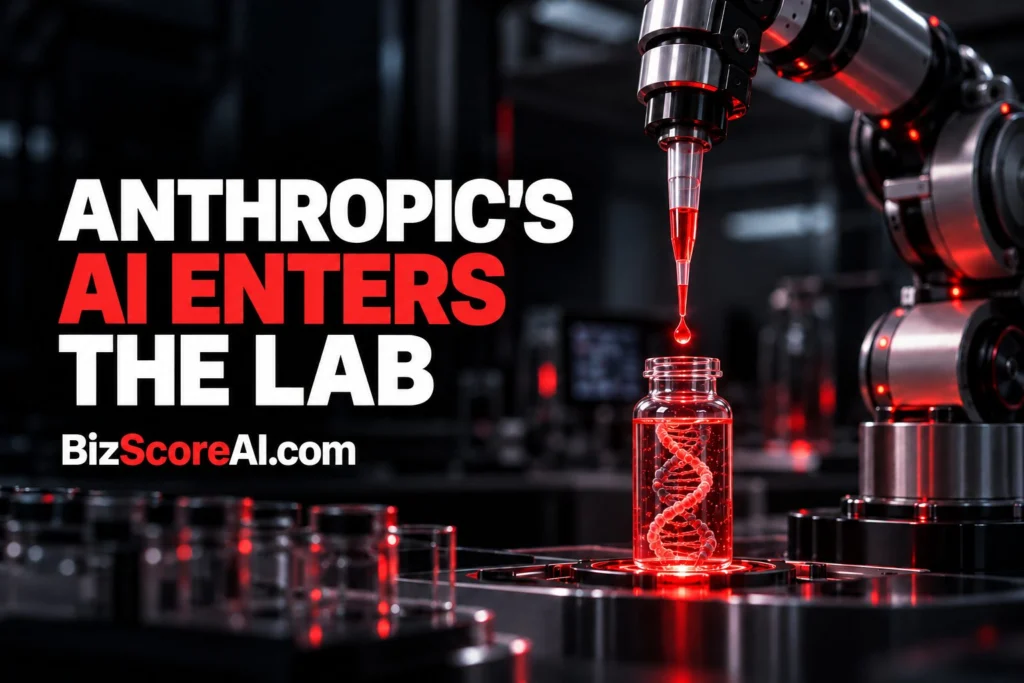
Anthropic has opened its first wet laboratory for biological research, moving the AI company from purely computational biology work into hands-on lab experiments aimed at finding treatments for rare and difficult-to-treat diseases. The facility sits in the San Francisco Bay Area and pairs Anthropic’s Claude AI with robotic lab automation to run physical science experiments.
Beyond the lab itself, the company has expanded its biology push through new science software, the addition of Novartis CEO Vas Narasimhan to its board, and the acquisition of a biotech startup for $400 million in stock. Separately, Anthropic’s CEO called for a new framework to govern advanced AI research, and the US and China are scheduled to hold an AI safety summit later this month.
Why Anthropic Built a Physical Lab
The new facility is designed for wet-lab work, meaning experiments done with physical biological samples rather than only computer simulations. Anthropic has said it wants to find treatments for rare diseases, and the company has now moved beyond “in silico,” or strictly computer-based, biology evaluations into actual lab work.
Anthropic’s head of life sciences described the approach in plain terms: the final test of biological research still happens in a real lab. The team’s setup mirrors what most biotech companies do, splitting work between in-house facilities and external partners. The lab is built around automation, with Claude directing robots to carry out science experiments.
Focus on Undruggable Diseases
Anthropic has said its biology program will focus on conditions the pharmaceutical industry has neglected, especially diseases considered “undruggable” because they are too expensive or scientifically difficult to treat with today’s tools. The combination of large AI models with robotic experimentation is meant to screen and test potential therapies faster than traditional pipelines.
Recent Moves in Biology and Pharma
Anthropic has made several moves that point in the same direction:
- Launched new science software aimed at researchers.
- Added Novartis CEO Vas Narasimhan to its board, deepening ties to the pharmaceutical world.
- Acquired a biotech startup for $400 million in stock.
- Opened its first wet lab in the San Francisco Bay Area, with Claude directing robotic experiments.
What This Means for AI in Pharma
For drug discovery, the interesting shift is that the lab lets Anthropic close the loop between AI prediction and wet-lab confirmation. Models can generate hypotheses about a protein or a molecule, and a robotic system can immediately set up and run the physical experiment to test them. That same loop is what large biotech companies have spent decades building, and bringing it under one roof puts AI lab work on a more equal footing with established pharma research.
For researchers studying rare or undruggable conditions, a new entrant with serious compute, automation, and funding may open paths that existing companies have not pursued. For the broader AI industry, the move signals that frontier model labs are willing to invest in physical infrastructure, not just software, to expand their reach into science.
The Governance Conversation Running in Parallel
The lab launch landed against a wider debate about AI safety and export controls. Anthropic’s CEO called for a new framework to govern AI research and ensure advanced systems stay within agreed limits, and urged the US government to tighten controls on exporting advanced chips to China. His main stated worry is what happens if China does not agree to slow AI advancement.
That proposal drew public support from OpenAI CEO Sam Altman and Elon Musk on social media. President Trump has framed the issue differently, saying the United States is leading in AI and should stay ahead, calling some warnings about AI “very negative forces” exaggerating the threat. The US and China are scheduled to hold a summit on AI safety risks this month, and AI is expected to come up at the Trump-Xi meeting set for 24 September.
What to Watch Next
- First published results: whether the lab produces experimental findings that move forward the rare-disease programs it has publicly named.
- Partnership structure: how much of the biology work runs inside Anthropic’s own facilities versus with external biotech and pharma partners.
- Regulatory signal: how the US-China AI safety summit, and the 24 September Trump-Xi meeting, shape export controls on advanced chips.
FAQ
What is Anthropic’s new wet lab?
Anthropic has built a wet laboratory in the San Francisco Bay Area for physical biological experiments. It uses Claude AI to direct robots that carry out the science work, with the stated goal of finding treatments for rare diseases.
Why is the lab focused on undruggable diseases?
Anthropic has said its biology program aims at conditions the pharmaceutical industry has neglected, including diseases considered “undruggable” because they are too expensive or difficult to treat with current approaches. Pairing large AI models with robotic lab automation is meant to speed up the search for those therapies.
How does this fit with Anthropic’s other recent moves?
The lab opens alongside new science software from Anthropic, the addition of Novartis CEO Vas Narasimhan to its board, and a $400 million stock acquisition of a biotech startup, all pointing to a deeper push into pharmaceutical research.
See our editorial disclaimer for how our articles are produced.
Run a free scan to see your AI Visibility Score, SEO rating, and local citation accuracy.