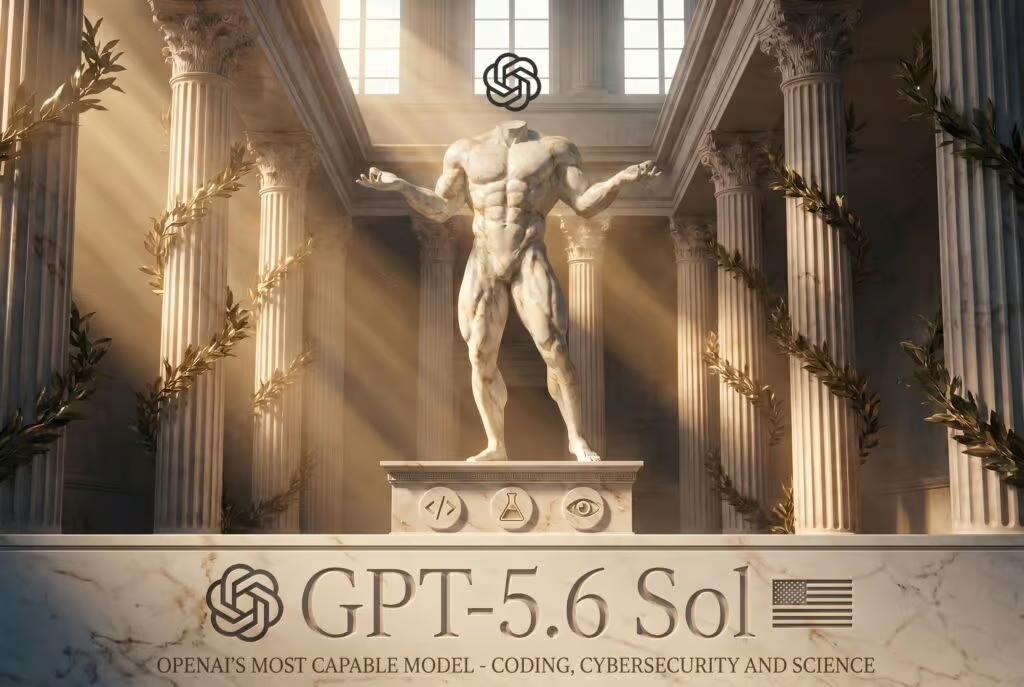
OpenAI has begun a limited preview of GPT-5.6 Sol, its next-generation flagship model that introduces a subagent-powered "ultra" mode and sets new performance records in coding, biology, and cybersecurity. The rollout is a rare government-coordinated limited access phase, with the U.S. administration requesting a temporary gate before broader release. Sol ships alongside Terra, a 2x cheaper model competitive with GPT-5.5, and Luna, the most affordable option yet.
GPT-5.6 Sol’s ultra mode uses subagents to break through the complexity ceiling of single-agent AI.
Why It Matters
Frontier AI models are becoming increasingly autonomous, with capabilities that blur the line between assistance and independent action. GPT-5.6 Sol represents a meaningful step forward in agentic workflows, complex tasks that require planning, tool use, and multi-step coordination. With models now demonstrating advanced vulnerability research and exploitation skills, the stakes around who benefits from these capabilities and how they are safeguarded have never been higher. OpenAI is explicitly building a safety stack tailored to each model variant, preserving legitimate defensive uses like code review, patch development, and security education while making prohibited offensive activity more difficult and detectable.
What’s New in the GPT-5.6 Series?
The GPT-5.6 series consists of three models: Sol, the flagship; Terra, a balanced option for everyday work; and Luna, a fast, low-cost version. What sets Sol apart is a new max reasoning effort that allows it to think deeply on the hardest problems, and a novel ultra mode that goes beyond a single agent. In ultra mode, the model spawns subagents that work in parallel to accelerate complex workflows, dramatically improving long-horizon task completion across coding, biology, and cybersecurity domains.
Terra achieves performance competitive with GPT-5.5 while being twice as cheap to run, and Luna brings strong capabilities at the lowest price in the lineup. All models have been stress-tested with automated red-teaming, layered safeguard configurations, and coordination with the U.S. government ahead of today’s preview.
What Did the Benchmarks Show?
- Terminal-Bench 2.1: GPT-5.6 Sol sets a new state of the art on this benchmark for command-line workflows that require planning, iteration, and tool coordination.
- GeneBench v1: Achieves stronger results on long-horizon genomics and quantitative-biology analyses than GPT-5.5, while using fewer tokens.
- ExploitBench: Sol is competitive with Mythos Preview using approximately one-third of the output tokens, shifting the performance-efficiency frontier for security tasks.
- ExploitGym: All three model variants (Sol, Terra, Luna) show strong improvements in cyber capabilities as reasoning increases, as recorded by a benchmark created by UC Berkeley researchers in collaboration with OpenAI and other frontier labs (arXiv:2605.11086).
“GPT-5.6 Sol is better at helping people find and fix vulnerabilities than reliably carrying out end-to-end attacks.”, OpenAI
Complete safety and preparedness evaluations for the preview are available in the GPT-5.6 Sol system card.
What Comes Next?
OpenAI plans to make GPT-5.6 Sol, Terra, and Luna generally available in the coming weeks. During the limited preview, the company will continue testing with trusted partners whose participation has been shared with the government. An expanded set of evaluation results will be published alongside the broader launch. In parallel, OpenAI is working with the Administration to develop a cyber Executive Order framework and a repeatable process for future model releases. The company has stated it does not believe a government access process should become the long-term default, describing the current step as the strongest path to widespread availability while a permanent framework is built.
What Does This Mean for Developers and Security Teams?
For developers, security teams, and business leaders, the GPT-5.6 series signals a tangible jump in AI’s ability to handle multi-step technical work. Coding assistants built on Sol could reason across entire codebases and orchestrate complex debugging sessions. Cyber defenders gain a tool that is specifically designed to find and patch vulnerabilities faster, while offensive misuse is actively constrained by the safety architecture. The government’s involvement in the rollout also means that anyone deploying frontier models should expect growing compliance and governance requirements.
Our earlier coverage on the government request that shaped this staggered ChatGPT rollout provides deeper context on the policy angle. Meanwhile, competition is intensifying: open-source models like Qwen3.6-27B are already hitting coding benchmarks that rival much larger systems, showing that the performance landscape is shifting fast on multiple fronts.
The Bigger Picture
The limited preview of GPT-5.6 Sol represents a critical moment where advanced AI performance intersects with national security concerns. OpenAI’s cautious, government-coordinated launch could set precedent for how the most powerful AI systems reach the public. With subagent-driven ultra modes and explicit cyber safety postures, the next wave of models is redefining what responsible release looks like. As the industry balances innovation with safeguards, expect more transparency, more collaboration with regulators, and a clearer template for managing the capabilities that frontier AI now wields.
FAQ
What is GPT-5.6 Sol and what is ultra mode?
GPT-5.6 Sol is OpenAI’s next-generation flagship model, previewed in June 2026. It introduces a maximum reasoning effort setting and an ultra mode that spawns subagents to work in parallel, breaking through the complexity ceiling of single-agent AI on long-horizon tasks in coding, biology, and cybersecurity.
Why is GPT-5.6 being released as a limited preview?
The limited preview is happening at the request of the U.S. government. OpenAI shared its plans and the models’ capabilities ahead of the launch, and the government asked that initial access be restricted to a small group of trusted partners whose participation has been disclosed, as a short-term step before broader availability.
What benchmarks did GPT-5.6 Sol improve on?
Sol set a new state of the art on Terminal-Bench 2.1 for command-line workflows, outperformed GPT-5.5 on GeneBench v1 for genomics analyses while using fewer tokens, and was competitive with Mythos Preview on ExploitBench using roughly one-third of the output tokens. On ExploitGym, all three GPT-5.6 models showed strong cyber capability gains as reasoning effort increased.
Sources
Related coverage
Run a free scan to see your AI Visibility Score, SEO rating, and local citation accuracy.