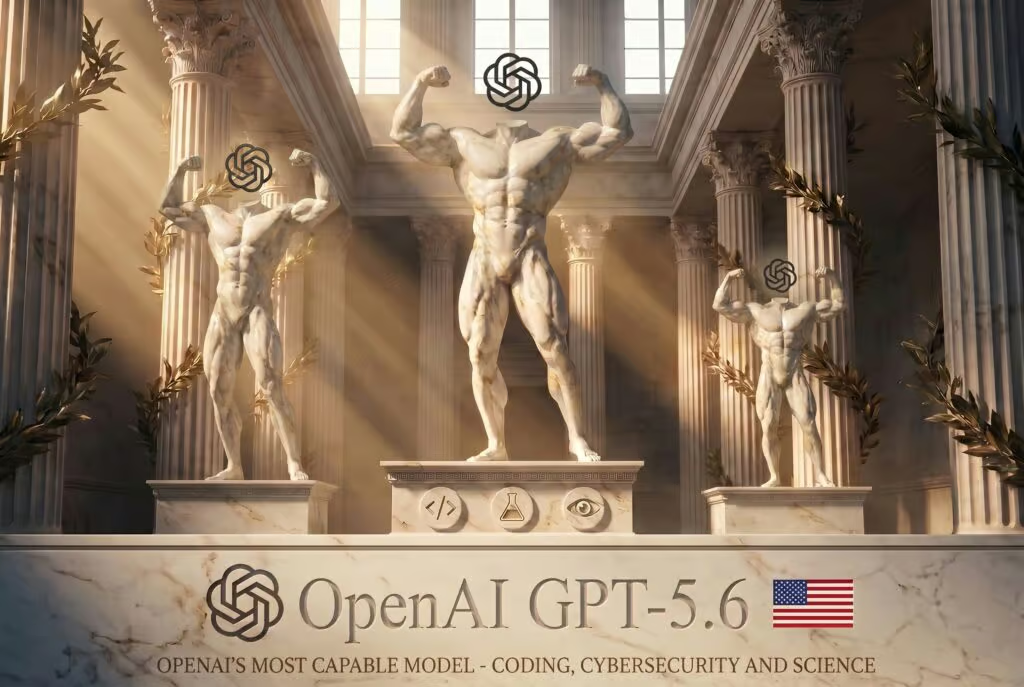
OpenAI is releasing GPT-5.6 on Thursday, July 9, 2026, bringing its most capable model family to general availability after a limited preview that began in late June. The release introduces three models: Sol, the flagship; Terra, a balanced everyday model; and Luna, a fast, affordable option.
What arrives tomorrow
General availability opens July 9 for the entire GPT-5.6 family, following a preview window that started with a small group of trusted partners in coordination with the U.S. government. OpenAI has stated it does not want the government access process to become a long-term default, framing the limited preview as a short-term step toward broader release.
In the new naming scheme, the number identifies a model’s generation, while Sol, Terra, and Luna identify durable capability tiers that can advance on their own cadence. That separation matters for businesses planning roadmaps around capability levels rather than version numbers.
What new reasoning modes does GPT-5.6 add?
GPT-5.6 introduces a max reasoning effort setting that gives Sol the most time to reason deeply before responding. An ultra mode goes beyond a single agent by leveraging subagents to accelerate complex work. Together, these modes give developers finer control over the latency-versus-depth trade-off.
How does GPT-5.6 perform on coding, biology, and cybersecurity?
OpenAI positions Sol as a new state of the art on Terminal-Bench 2.1, a benchmark for command-line workflows requiring planning, iteration, and tool coordination. For biology workflows, Sol delivers stronger results than GPT-5.5 on GeneBench v1, a long-horizon genomics and quantitative-biology benchmark, while using fewer tokens.
On cybersecurity, Sol is OpenAI’s most capable model yet. On ExploitBench, Sol is competitive with Mythos Preview while using only about one third of the output tokens. On ExploitGym, a benchmark created by UC Berkeley researchers in collaboration with OpenAI and other frontier labs, Sol, Terra, and Luna all show strong improvements as reasoning effort increases.
OpenAI emphasizes that stronger capability comes with stronger safeguards. Sol is better at helping people find and fix vulnerabilities than at reliably carrying out end-to-end attacks, and the company states it does not cross the Cyber Critical threshold under OpenAI’s Preparedness Framework. In Chromium and Firefox evaluations, Sol identified bugs and exploitation primitives but did not autonomously produce a functional full-chain exploit under the conditions tested.
What does the safety stack include?
GPT-5.6 ships with what OpenAI calls its most robust safety stack to date, configured per model tier:
- Refusal training that holds up when users attempt to disguise intent or jailbreak the model.
- Real-time cyber and biology misuse classifiers that evaluate output as it is generated and can pause generation for review by a larger reasoning model on higher-risk cases.
- Account-level review triggered by flagged activity.
- Differentiated access matched to each model’s capabilities.
- Automated red-teaming, with over 700,000 A100-equivalent GPU hours dedicated to finding universal jailbreaks, plus ongoing third-party human red-teaming through the preview period.
OpenAI notes that users may encounter blocks or refusals during the preview and is collecting feedback to reduce unnecessary blocks before wider release.
How is GPT-5.6 priced?
GPT-5.6 is priced per million tokens across three tiers:
- Sol: $5 input / $30 output
- Terra: $2.50 input / $15 output
- Luna: $1 input / $6 output
Terra is priced to be competitive with GPT-5.5 while costing roughly half as much, and Luna brings strong capability to OpenAI’s lowest price point. The release also introduces more predictable prompt caching: explicit cache breakpoints, a 30-minute minimum cache life, cache writes billed at 1.25x the uncached input rate, and cache reads continuing to receive the 90% discount.
What is the Cerebras deployment?
OpenAI is launching GPT-5.6 Sol on Cerebras at up to 750 tokens per second in July, with access initially limited to select customers. The deployment targets latency-bound workloads such as high-throughput coding agents and real-time analysis.
What should developers expect on day one?
From July 9, developers can expect API and Codex access to all three tiers, while ChatGPT availability rolls out more broadly. Teams already running GPT-5.5 in production should evaluate Terra first for cost-per-token parity checks, then test Sol on Terminal-Bench 2.1-style agentic tasks to see whether the new max and ultra modes translate into measurable gains on real workflows. For budget-sensitive use cases, Luna now sets the floor for what frontier-tier capability costs.
The bigger story is structural. By separating generation numbers from capability tiers, OpenAI is giving enterprises a stable target to plan against. Sol, Terra, and Luna are the names to track as they advance on their own cadence, independent of the next version number.
FAQ
When does GPT-5.6 go to general availability?
GPT-5.6 reaches general availability on Thursday, July 9, 2026, following a limited preview that began in late June with a small group of trusted partners in coordination with the U.S. government.
What are the Sol, Terra, and Luna tiers?
Sol is the flagship model, Terra is a balanced everyday model, and Luna is a fast, affordable option. The number (5.6) identifies the generation, while Sol, Terra, and Luna identify durable capability tiers that can advance independently of version numbers.
How much does GPT-5.6 cost per million tokens?
Sol is priced at $5 input / $30 output, Terra at $2.50 input / $15 output, and Luna at $1 input / $6 output per million tokens. Cache writes are billed at 1.25x the uncached input rate with a 30-minute minimum cache life, and cache reads continue to receive a 90% discount.
Related coverage
Run a free scan to see your AI Visibility Score, SEO rating, and local citation accuracy.