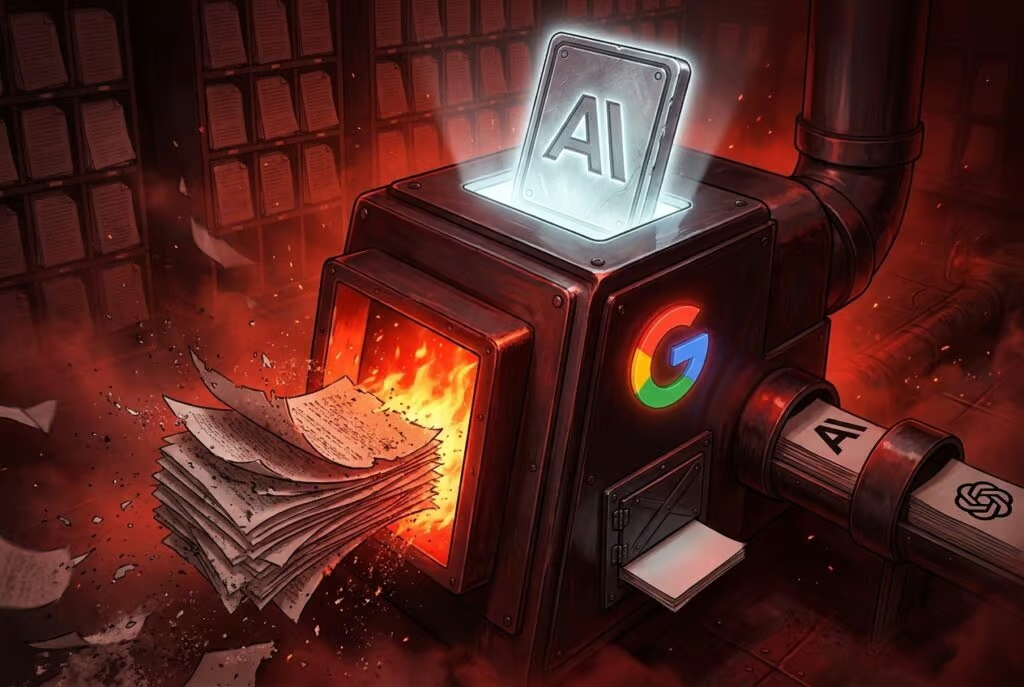
Google quietly filed its new Guide to Optimizing for Generative AI Features on Google Search inside Search Central’s SEO Fundamentals section, right beside the SEO Starter Guide, signaling that optimizing for AI Overviews is still SEO. The guide’s sharpest warning is aimed at generic content anyone (or any model) could write, the kind most at risk of being replaced by AI answers.
Why It Matters
The guide dropped a week after Google I/O wrapped, where the company confirmed AI Overviews now reach billions of users and that Search is becoming a place where answers get generated on the page instead of just linked out to. For business owners, that shift is already showing up as falling click-through rates: when the AI answers the question inside the results, fewer people click through to your site.
Into that vacuum rushed a whole consulting market built around "AEO frameworks," "GEO audits," and llms.txt files sold as the new must-have fix. Google’s guide is, in the driest possible language, pushing back on most of it. The company explicitly mentions AEO and GEO, then folds them right back under plain SEO. From Google’s point of view, there is no separate discipline to buy.
That matters for you because it changes where to spend limited time and budget. If your business has been told it needs a brand-new AI playbook to stay visible, Google is saying the opposite: the fundamentals you already know still decide whether an AI surfaces you.
What’s New / How It Works
Two ideas from the guide explain why "just do SEO" is the honest answer. The first is RAG (retrieval-augmented generation): AI Overviews are built from real pages in Google’s index. The system retrieves relevant content from Search and uses it to generate the answer. If your page is indexed, ranks well, and is technically eligible, it can be pulled into an AI Overview.
The second is query fan-out. For a complex question, Google doesn’t run one search, it fires off several related searches at once and stitches the results into a single answer. Your page doesn’t have to match the exact wording of the user’s question. A deep, genuinely useful page can surface because it answered one of the related sub-questions. Depth and semantic relevance now matter more than exact-match keyword targeting.
There’s also one technical detail most teams missed: to appear in a generative AI feature, a page must be indexed and eligible to show a snippet. A page carrying a nosnippet tag is invisible to AI Overviews even if it ranks beautifully. For many sites, nosnippet has been treated as a throwaway setting, now a careless tag can quietly block your most valuable pages from AI results.
What the Guide Says You Can Stop Doing
The sharpest part of the guide is the section titled "What you don’t need to do." Google doesn’t publish mythbusting lists preemptively, it names tactics only after they’ve spread far enough to warrant a public correction. Here’s what Google says you can stop worrying about for its AI search:
- llms.txt files, no special treatment from Googlebot (they may still matter for Anthropic, OpenAI, and Perplexity crawlers, which work differently).
- Chunking content into short "AI-digestible" paragraphs, Google’s systems already understand context across multi-topic pages.
- Rewriting copy for AI, the model handles synonyms and meaning; a lawn-care page doesn’t need the exact string "how to fix a lawn full of weeds" to be cited for it.
- Inauthentic mentions, planting fake brand mentions across forums and roundups does nothing; the same spam rules apply.
- Over-investing in structured data, no schema markup unlocks AI Overview eligibility (keep it for rich results, not as an AI lever).
Buried in the quality recommendations is the idea that deserves the most attention: the line between commodity and non-commodity content. Commodity content, Google’s example is "7 Tips for First-Time Homebuyers", is "common knowledge, available from anyone, adds no unique insight." Non-commodity content is the first-hand account only you could write. The test is brutal in its simplicity:
"Are we creating something useful enough that people, and AI systems, would miss it if it disappeared?"
Google’s message is blunt: if an AI can write your page in seconds, that page was never your moat to begin with.
What Comes Next
The guide also points to where Search is heading. Google I/O previewed AI agents that watch the web for you around the clock, and Search itself becoming more interactive, less a list of links, more a place where tasks get completed. That agentic direction raises the stakes on a simple question: can an automated system actually find, read, and act on your business information?
The practical framework that falls out of the guide is short and doable without a consultant:
- Run a non-commodity audit on your top pages, flag anything a model could reproduce.
- Audit snippet eligibility (check for stray
nosnippettags) across high-value pages. - Consolidate thin, overlapping cluster pages before building more.
- Stop spending on
llms.txtand AI-specific markup for Google. - Invest in content types AI can’t generate: first-hand results, original data, named experience.
- If you’re in e-commerce or local, don’t overlook the feed and listing layer.
What This Means for You
If you run a small business, the non-commodity test is the most useful thing to take from all this, and it’s free to apply. Look at your top pages and ask whether a generative model could write the same thing in seconds. A generic "5 things to know before hiring a plumber" post is commodity content; "what we found behind the wall on a 1920s remodel, and the $4,000 it saved the homeowner" is not. The second carries proof of experience no model can fabricate, and that’s the content AI surfaces instead of replaces.
Two practical moves follow. First, make sure AI systems can actually reach you: confirm your pages are indexed and snippet-eligible, and check that your AI-contactability is solid, there’s no point writing irreplaceable content an AI can’t retrieve. Second, get the fundamentals in place, because RAG pulls from indexed, ranked pages: claim and complete your business listing and tighten your local SEO so the signals Google still rewards are actually there.
This connects directly to what we covered when Google rolled out its new AI search box, and to the cheap, self-serve audit tooling in our Gemma 4 + OpenClaw listing-audit guide. You don’t need to hire an AI-search specialist to act on any of this, you need to know which of your pages an AI could replace, and fix the plumbing that lets AI find the ones it can’t.
The Bigger Picture
Strip away the jargon and Google’s guide is a forecast: as AI Overviews absorb the easy answers, the businesses that stay visible will be the ones publishing things that could only come from them, real numbers, real outcomes, real experience, on pages that are technically reachable by the systems doing the retrieving. Generic content was always replaceable; now it’s being replaced in public. Audit what only you can say, make sure an AI can read it, and you’re optimizing for exactly the future Google just described.
FAQ
Does a nosnippet tag actually block my pages from AI Overviews?
Yes. To appear in any generative AI feature, a page must be indexed and eligible to show a snippet in Google Search. A page carrying a nosnippet tag is ineligible, so even strong, well-ranking content won’t appear in AI Overviews if that tag is present. Many teams treat nosnippet as a minor technical setting, but a misapplied tag can silently remove your most valuable pages from AI results.
What is the non-commodity content test from Google’s guide?
It’s a question the guide implies: could a generative AI model produce an equally useful version of this page? If the answer is yes, the page is commodity content, common knowledge available from anyone, the kind AI Overviews are built to replace. Non-commodity content is first-hand experience, original data, or insights only you could write. Google’s framing: "Are we creating something useful enough that people, and AI systems, would miss it if it disappeared?"
Is AI search optimization a separate discipline from SEO?
According to Google, no. The guide was published inside Search Central’s SEO Fundamentals section, and the company explicitly folds AEO and GEO back under ordinary SEO. AI Overviews are built through retrieval-augmented generation from real indexed pages, so the same fundamentals that earn rankings also earn AI citations. You don’t need a new playbook or a specialist retainer, you need solid SEO basics and content only you could have written.
Related coverage
Run a free scan to see your AI Visibility Score, SEO rating, and local citation accuracy.